50 Questions to Ask an Activewear Manufacturer Before Placing an Order
- Share
- publisher
- Ohsurewear
- Issue Time
- Nov 11,2026
Summary
Ask these 50 questions before ordering activewear. Verify materials, samples, MOQ, costs, quality checks and delivery with a practical evidence-based buyer checklist.
B729-99 · ACTIVEWEAR SOURCING CHECKLIST
A practical buyer checklist with the evidence to request, the decisions to record and the approvals to close.
Before ordering activewear, verify the supplier’s identity, product capability, materials, sample approvals, minimum quantities, full costs, production milestones, inspection rules and shipping responsibilities. Ask for written evidence linked to your garment and order. Use the 50 questions below in stages, and keep unresolved critical requirements on hold before payment, bulk production or shipment release.
What is a pre-order manufacturer questionnaire?
It is a structured request for information and evidence used to decide whether a supplier and a proposed order meet your requirements. It connects each answer to a garment specification, responsible person and approval stage. It helps a startup preparing its first order as well as a brand changing factories or developing a new construction.
For this checklist, OEM means production developed around the buyer’s supplied requirements; ODM includes supplier-led product-development input; and private label means goods carrying the buyer’s branding. Suppliers use these terms differently, and services can overlap. Define the actual deliverables, ownership and approval responsibilities before comparing offers.
Use MOQ to mean the minimum order quantity under the stated style, color and material conditions. An approved reference sample is the identified physical sample tied to the accepted specifications. An acceptance criterion is an agreed requirement for judging an item or inspection result. None of these is fully defined by saying “standard quality.”
Which questions should be resolved at each stage?
Start with identity, capability and commercial fit. Resolve the remaining details at the approval stage where they affect the next commitment. Set the required timing for each question in your own project.
| Decision | Priority questions | Evidence to review | Reason to hold |
|---|---|---|---|
| Pay for development | 1–10, 21–24, 26–30 | Verified entity, relevant capability, development scope and written quote | Unexplained payee mismatch or undefined charges |
| Release bulk production | 11–20, 25–40 | Approved material and sample, final specification, quantity, schedule and quality plan | Unapproved substitutions or unresolved fit and acceptance criteria |
| Release shipment | 38–47, 50 | Agreed inspection disposition, packing and shipping documents, release approval | Unresolved agreed inspection failure or incorrect shipment details |
| Place a repeat order | 11–15, 26–35, 48–50 | Retained references and reconfirmed materials, quote and dates | Assuming the previous order’s conditions still apply |
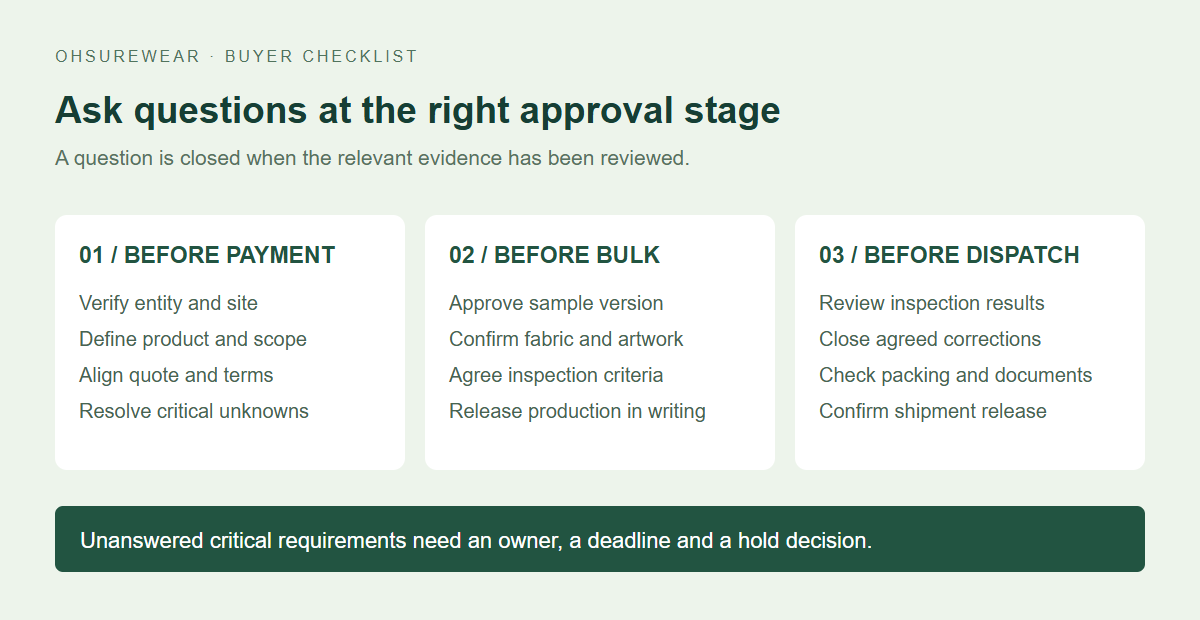
The 50 questions, with evidence to request
Keep supplier statements, documents and your own review findings distinct. The notes below describe evidence to request; they do not assert that every supplier provides it.
Supplier identity and production responsibility
1. What legal entity will sign the order and receive payment?
Request / confirm: Request the registered name, business details and matching quotation, invoice and payment instructions. Resolve any mismatch before paying.
2. Which production site will make this order?
Request / confirm: Ask for the site address, its relationship to the seller and a relevant visit, live walkthrough or independent verification option.
3. Which operations are performed in-house or subcontracted?
Request / confirm: Record who handles cutting, sewing, printing and packing, who controls outside work and how changes will be disclosed.
4. Can you show experience with a comparable garment?
Request / confirm: Review a relevant sample and construction details. A leggings sample alone does not establish capability for an adjustable nursing sports bra.
5. Who owns technical decisions and issue escalation?
Request / confirm: Obtain a named project contact, technical reviewer, escalation contact and agreed communication routine.
Service scope and development ownership
6. What does your OEM, ODM or private-label offer include?
Request / confirm: Request a deliverables list covering design input, patterns, fabric sourcing, samples, production and packing. Service labels alone are insufficient.
7. What must I provide before you can quote accurately?
Request / confirm: Send a versioned brief with garment drawings or references, target use, measurements, fabric, quantity, color split, artwork and required arrival date.
8. Who owns the pattern, artwork and development files?
Request / confirm: Confirm ownership, permitted use, access to files and any restrictions in writing before development begins.
9. How will you handle confidential designs and reference samples?
Request / confirm: Agree access, permitted sharing with subcontractors, retention and return arrangements. Do not assume a design is exclusive.
10. How are specification changes approved?
Request / confirm: Ask for a change log identifying the new version, cost and schedule impact, approver and the sample or order affected.
Materials and performance evidence
11. What exact fabric will be quoted and used?
Request / confirm: Record composition, construction, weight, finish, color reference and material identifier. Retain an agreed swatch; a fiber name is incomplete.
12. Is that material available for my quantity and colors?
Request / confirm: Confirm stock versus made-to-order sourcing, material minimums, reservation conditions and whether dyeing requires extra quantity.
13. How will stretch, recovery and opacity be evaluated?
Request / confirm: Agree garment sizes, colors, movement, lighting and assessment conditions. Review the intended fabric and fit; no single GSM value proves opacity.
14. Which durability or performance tests are relevant?
Request / confirm: Define the needed checks, such as shrinkage, colorfastness or pilling, their methods and acceptance criteria. Match reports to the proposed material.
15. What evidence supports recycled, organic or other material claims?
Request / confirm: Request relevant documents and traceability for the exact claim and order. Verify scope and validity; a general supplier certificate is insufficient.
For a leggings brief, review the custom gym leggings product range and identify the exact style and intended activity before discussing fabric and opacity checks.
Fit, construction and branding
16. How will measurements and grading be defined?
Request / confirm: Agree points of measure, measurement method, size chart, tolerances and grade rules. Specify whether measurements are relaxed or extended.
17. Which seams and construction details suit the garment?
Request / confirm: Review seam positions, stitch type, gusset, waistband, pockets and reinforcement on the actual sample against the intended movement and fit.
18. How will sports-bra support and comfort be reviewed?
Request / confirm: Define intended activity, size coverage, strap and band adjustment, cups and fit-review criteria. Avoid unsupported universal support claims.
19. Which logo application is suitable for this fabric?
Request / confirm: Ask for a trial using the proposed artwork, size, placement and process, with agreed stretch and wash checks where relevant.
20. Which labels, hangtags and packing details are included?
Request / confirm: Approve artwork, label content, placement, folding, bag and carton specifications. Assign responsibility for checking destination-market requirements.
For a bra project, use the custom sports bras product range to explain the required construction, then agree your own fit and support review.
Samples and approval control
21. What sample stages and deliverables are included?
Request / confirm: Identify development, fit, size-set or pre-production samples as needed. Record what each sample can demonstrate and its approval purpose.
22. What are the sample charges and revision terms?
Request / confirm: Separate development, materials, logo setup, revision and courier costs. Confirm any credit conditions rather than assuming samples are free.
23. Will the sample use the intended bulk materials?
Request / confirm: Record substitutions and unresolved checks. A substitute fabric or trim requires later confirmation before bulk approval.
24. When does the sample timeline start and what can change it?
Request / confirm: Obtain a dated milestone plan with start conditions, working or calendar days, material readiness, review time, revisions and courier transit.
25. How will the approved sample be tied to bulk production?
Request / confirm: Keep a tagged reference sample linked to the final tech-pack version, approved material, artwork, measurement record and written approval.
MOQ, quantities and quotation
26. What is the MOQ for each style and color?
Request / confirm: Ask whether mixed sizes are allowed and whether fabric, trims, printing or packaging create additional minimums.
27. What is the full order quantity by SKU?
Request / confirm: Confirm style, color and size breakdown, permitted over- or under-delivery, and how quantity differences affect payment and acceptance.
28. What exactly does the unit price include?
Request / confirm: Require a quote tied to the specification version, quantity, currency, validity period and agreed delivery basis, with inclusions and exclusions.
29. Which one-time or additional charges apply?
Request / confirm: List pattern work, setup, special materials, labels, tests, inspection, packing and transport charges. Mark included items to avoid double-counting.
30. What are the payment milestones and change terms?
Request / confirm: Confirm deposit and balance triggers, approved payment recipient, cancellation conditions and the process for pricing changes. Retain the agreed terms.
Production planning and delivery
31. When can materials and production capacity be allocated?
Request / confirm: Request a project-specific readiness plan and production window. A general monthly capacity statement does not reserve your order.
32. What must be approved before bulk production starts?
Request / confirm: List the required specification, material, sample, artwork, quantity and payment confirmations and who authorizes release.
33. What are the production and dispatch milestones?
Request / confirm: Obtain dates for material readiness, cutting, sewing, finishing, inspection and dispatch, with dependencies and named owners.
34. How will progress and delays be reported?
Request / confirm: Agree update frequency, evidence such as dated production records, and when a missed milestone must be escalated.
35. What happens if a material or schedule changes?
Request / confirm: Require written approval of substitutions and revised dates, plus an agreed contingency. Assess any change in fit, claims, price or testing.
Quality control and acceptance
36. Which quality checkpoints apply to my order?
Request / confirm: Ask for material, branding, in-process and final checks relevant to the garment, with responsibilities and records.
37. What defect definitions and acceptance rules will we use?
Request / confirm: Agree defect categories, tolerances, inspection scope and the sampling plan. Name any chosen AQL arrangement explicitly; do not assume one.
38. Can I arrange an agreed independent inspection?
Request / confirm: Confirm access, timing, scope, fees, report recipients and what must happen before shipment can be released.
39. How will color, size and production lots be traced?
Request / confirm: Ask how fabric lots and finished units are identified, how shade variation is managed and which records are retained.
40. What happens when inspection identifies a failure?
Request / confirm: Agree hold, sorting, rework, reinspection and release responsibilities, including cost allocation and written disposition.
Packing, shipping and receipt
41. How will unit packing and carton markings be approved?
Request / confirm: Confirm SKU labels, size and color identification, carton quantities, dimensions, weight information and any retailer-specific instructions.
42. What shipping arrangement and delivery basis are quoted?
Request / confirm: Request the named destination or place, route, responsibilities and charge breakdown. Confirm the actual arrangement available for this order.
43. How are transit estimates separated from production time?
Request / confirm: Ask for estimated dispatch and arrival dates, the basis of the estimate, booking assumptions and who handles clearance and final delivery.
44. Who prepares and checks the shipping documents?
Request / confirm: Agree the required invoice, packing list and applicable supporting documents, responsible parties and correction process before dispatch.
45. What receiving inspection and discrepancy records should I keep?
Request / confirm: Agree carton and quantity checks, photos, garment identification and a reporting procedure for visible damage or discrepancies.
Claims, repeat orders and final release
46. What is the defect-reporting process and deadline?
Request / confirm: Obtain the contact, required evidence, reporting window and response process in the order terms; do not assume a standard policy.
47. What remedies can be agreed for confirmed problems?
Request / confirm: Document how the parties will evaluate a claim and any agreed repair, replacement, credit or other remedy, including related costs.
48. What will be retained for repeat-order consistency?
Request / confirm: Confirm retention of the approved specification, sample, artwork, material reference and inspection records, and how future changes are reviewed.
49. Which assumptions could change on a reorder?
Request / confirm: Reconfirm material availability, MOQ, color consistency, pricing, lead time and setup charges. A repeat style still needs a current order confirmation.
50. What evidence and approvals are still missing before I commit?
Request / confirm: Create a final issue list with owners and deadlines. Keep unresolved identity, product, quality, commercial or delivery requirements on hold.
How to use the checklist in six steps
- Prepare one comparable brief. Give each shortlisted supplier the same garment specification version, size range, quantity split and required arrival date.
- Mark priorities and applicability. Select what must be resolved before each commitment. Record a reason for anything marked not applicable.
- Collect answers in one record. Use columns for question number, answer, evidence reference, source and date, reviewer, status, open action, owner and deadline.
- Review the evidence. Match documents and samples to the actual entity, site, style and material. Ask follow-up questions where the match or scope is unclear.
- Close the next approval stage. Use “Verified,” “Open” or “Not applicable with reason.” A promised document stays open until reviewed; a high response count cannot cancel a critical unresolved item.
- Freeze the approved version. Attach the final brief, quote, sample record, milestones and quality arrangements to the order confirmation. Reopen affected questions after a change.
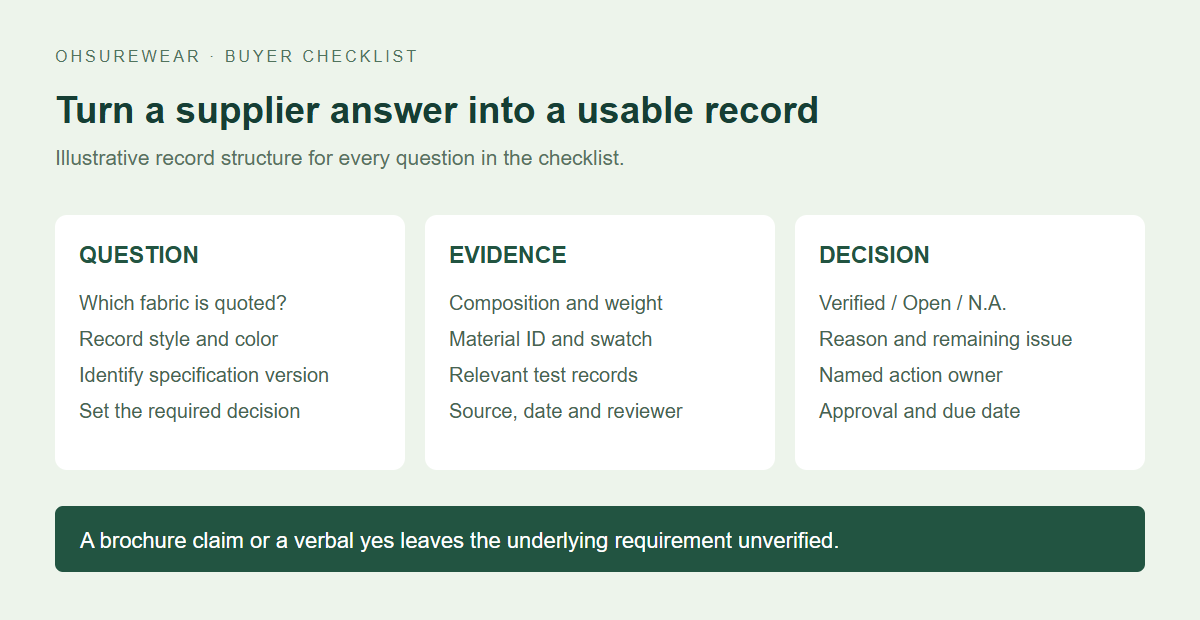
Example: turning a vague answer into a decision
A supplier replies, “Yes, we can make squat-proof leggings.” Keep question 13 open. Send the intended sizes, colors, fit and movement conditions; request a sample in the proposed material and agree the review method. Record what was observed and any limits. Approve that identified sample only when the agreed criteria are met. This is an illustrative workflow, not a test result or customer case.
Cost and time factors to confirm before ordering
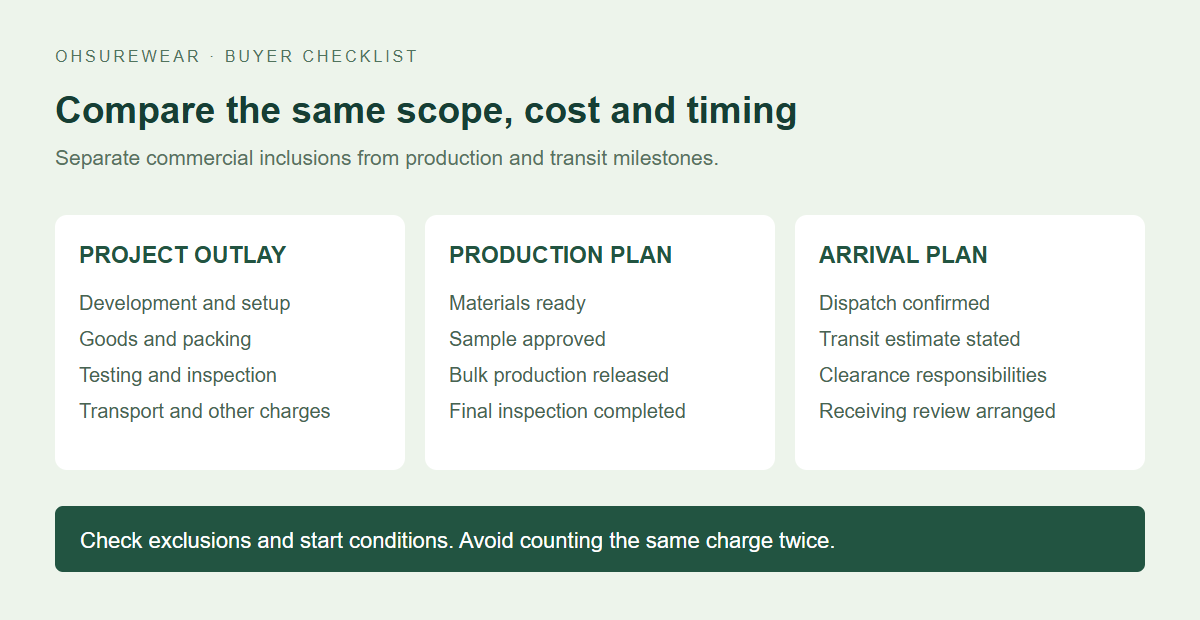
Compare the full scope of the commitment. A low unit price may exclude development, printing setup, labels, testing or shipping. Record both the amount and what it covers.
Comparable project outlay = development and setup + goods + agreed testing and inspection + packing + transport + applicable destination charges and other agreed costs. Include each charge once.
Illustrative calculation: for 500 garments, $10 per unit plus $700 in extras totals $5,700. A $9.50 unit price plus $1,200 in extras totals $5,950. The first offer is $250 lower on those assumptions. These figures are invented to explain the comparison and are not an Ohsurewear quotation.
| Factor | Weak answer | Useful confirmation |
|---|---|---|
| MOQ | “100 pieces” | Minimum per style and color, mixed-size rules and additional material minimums |
| Sample timing | “One week” | Start event, working/calendar days, sample scope, material readiness and revision assumptions |
| Bulk timing | “Fast production” | Approved specification, material availability, production slot and dated milestones |
| Arrival | “Ships this month” | Dispatch estimate, transit estimate, named destination and clearance responsibilities |
| Total cost | Unit price only | Same specification, quantity, delivery basis and itemized inclusions/exclusions |
Plan the order as a sequence: material confirmation, sample development, buyer review, revisions if required, production release, manufacturing, inspection, dispatch and transit. Some work may overlap when agreed. Ask which dependencies control the arrival date and make contingency time visible; a production duration alone cannot establish the arrival date.
Common mistakes that leave buyers exposed
- Sending 50 questions without a product brief. Supply the garment and quantity context so answers can be specific.
- Accepting “yes” as evidence. Ask which document, sample or control supports the answer and record who reviewed it.
- Checking only the best-looking sample. Tie approval to the intended bulk material, specifications and quality plan.
- Combining styles and colors under one MOQ. Calculate each applicable minimum and clarify material constraints.
- Treating every certificate as product proof. Check its exact relevance, validity and connection to the order.
- Confusing dispatch with arrival. Separate factory milestones, freight transit and destination handling.
- Leaving failure handling until a defect occurs. Agree inspection disposition and claim procedures before committing.
- Counting answered questions as approval. Close critical issues with evidence, even if the other 49 answers are complete.
Manufacturer perspective: preparing an actionable Ohsurewear inquiry
The supplied Ohsure article fact library describes a Dongguan-based manufacturer supporting OEM, ODM and private-label activewear projects. Its custom activewear manufacturing service outlines fabric sourcing, sampling, manufacturing and packing support. Turn those service categories into a defined project scope using questions 6–10.
The fact library records MOQ starting at 100 pieces per style per color, with mixed sizes available, subject to project confirmation. For example, two styles in two colors imply 400 pieces if that minimum applies to every combination. Ask whether the proposed material, branding or packaging changes the order requirements.
Use the fabric guide to prepare material questions and the private-label service page to define branding and packing requirements. Confirm the actual material and application details for your order. Listed options alone do not prove availability or performance.
The quality-control page describes material, printing-process, semi-finished and finished-garment inspection stages. Ask which checks, records and acceptance rules will apply to your garment. A published QC description does not establish a specific independent test result or an agreed sampling standard.
From a production-planning perspective, a reference photograph starts a discussion; measurements, material identification, construction details, artwork and consolidated sample comments make the next decision clearer. Send one current specification version and name the buyer who can approve changes.
The supplied fact library flags differing sample and bulk-production timelines across public pages. Obtain project-specific timing and start conditions. This section summarizes supplied facts and public service descriptions; it does not present an employee interview, measured customer outcome or guaranteed delivery commitment.
Frequently asked questions
What should I ask an activewear manufacturer first?
Start with the contracting entity, production site, experience with your garment, service scope, applicable MOQ and quote requirements. Send a clear brief so the response addresses your actual style, material, quantity and delivery needs.
Do I need answers to all 50 questions before paying for a sample?
Resolve identity, scope, sample charges, revision terms and any requirements essential to development first. Record when the remaining questions must be closed. Bulk-material, quality and shipment decisions can be completed at their relevant approval stages.
What is Ohsurewear’s starting MOQ?
The supplied fact library records MOQ starting at 100 pieces per style per color, with mixed sizes available. Final requirements depend on project confirmation, including the selected material, branding and packaging.
Can I approve bulk production using a photograph?
A photograph alone cannot establish measurements, fit, construction or material behavior. Agree the sample review and required evidence, then link written approval to the identified sample, material and final specification version.
How do I compare two manufacturers with different prices?
Align the garment specification, quantity, service scope and delivery basis first. Compare the full project outlay and exclusions, then review evidence for product capability, quality controls and delivery planning. Keep critical unresolved requirements separate from price.
What if the manufacturer cannot provide evidence?
Record the question as open, identify what is missing and agree an owner and deadline or an acceptable alternative verification method. If the requirement is mandatory for the next commitment, keep that commitment on hold.
What lead time should I put in my launch plan?
Use a project-specific sequence covering materials, sampling, review, revisions, production, inspection, dispatch and transit. Confirm start conditions, working or calendar days and contingency. The supplied fact library does not establish one consistent universal Ohsurewear lead time.
Should I reuse the checklist for repeat orders?
Yes. Reconfirm materials, quantities, current price, timing and any changes to specifications or processes. Link the reorder to retained approved references and record any new approval requirements.