Common Maternity Activewear Fit Problems and How Manufacturers Solve Them
- Share
- Issue Time
- Oct 29,2026
Summary
Diagnose maternity activewear fit problems: rolling waistbands, slipping leggings, crotch fit and riding hems, with sample corrections and approval steps.
B729-68 · MATERNITY ACTIVEWEAR DEVELOPMENT
Manufacturers address maternity activewear fit problems by checking body measurements, pattern balance, fabric stretch and recovery, seam construction, and size grading together. Rolling waistbands, slipping leggings and riding hems can have different causes. The reliable approach is to reproduce the issue, change a defined variable, compare revised samples and confirm the result before bulk production.
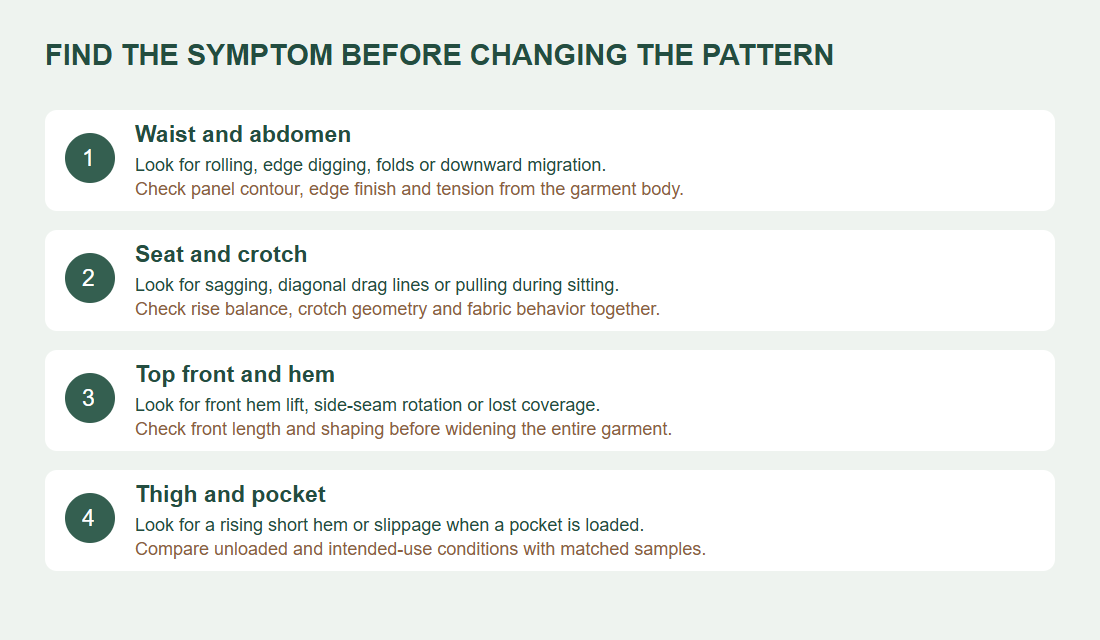
A maternity legging can look smooth on a mannequin yet slide during sitting. A top may have enough circumference but still ride up because the front length is insufficient. For brands, the expensive mistake is treating every complaint as a request for a larger size. A useful fit review identifies where the garment moves, what pulls it and whether the material returns to shape.
1. What is a maternity activewear fit problem?
A fit problem is a mismatch between the finished garment and the intended body measurements, coverage, movement or comfort requirements. It can arise from the pattern, material, assembly or size architecture. A manufacturing defect is a departure from the approved specification. The two can overlap, but a garment made exactly to an unsuitable pattern can still fit poorly.
Ease is the difference between body and garment dimensions. Stretch garments may use negative ease, meaning the garment is smaller than the corresponding body dimension before extension. The appropriate amount depends on the actual fabric, construction and intended fit. A composition label such as nylon/spandex does not establish how much negative ease is appropriate.
Recovery describes how well a material returns toward its original dimensions after extension under defined conditions. Grading changes a base pattern into a size range. Maternity development also requires a defined accommodation range for abdomen shape and front length; simply enlarging all dimensions proportionally can create excess fabric elsewhere.
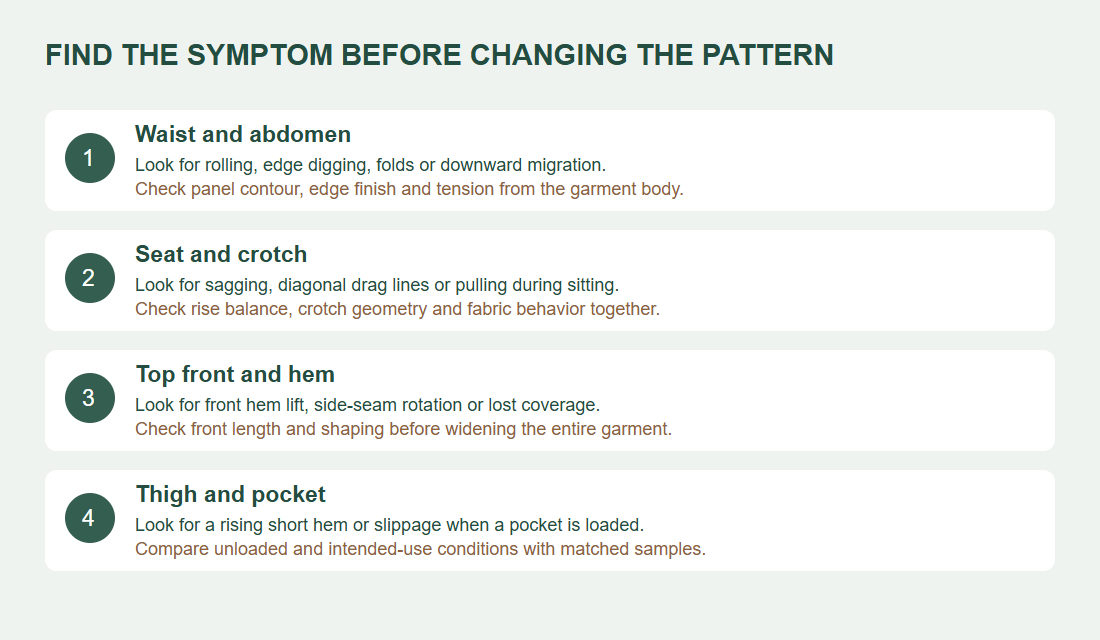
2. Common symptoms, possible causes and sample corrections
| Observed problem | Possible causes to investigate | Candidate manufacturer correction | What to recheck |
|---|---|---|---|
| Waistband rolls or folds | Edge tension, panel height or contour, seam bulk, mismatch between panel and body | Revise panel geometry or edge finish; compare elastic and seam options | Sitting, position changes and repeat adjustment |
| Leggings slip down | Insufficient anchoring, low recovery, rise imbalance, downward pull from legs or pockets | Review waist-to-hip balance, rise and material; isolate pocket loading | Migration with and without intended pocket contents |
| Front edge digs in | Local circumference or edge construction mismatch | Reshape the edge, review elastic specification or redistribute ease | Contact at front, side and back during sitting |
| Crotch sags or pulls | Incorrect front/back rise balance, crotch shape or recovery | Review pattern balance and leg-body tension before changing waistband alone | Standing and sitting fit, wrinkles and seam position |
| Fabric becomes too sheer | Excessive extension, unsuitable fabric construction or color | Reduce local strain or compare alternative material and construction | Finished garment coverage under consistent lighting |
| Top hem rides upward | Insufficient front length or shaping, restrictive hem, unsuitable proportion | Add targeted front length or shaping; reconsider hem width | Front/back coverage and side-seam balance |
| Short hem climbs | Thigh geometry, inseam, edge tension or friction | Compare leg opening, inseam and hem finish | Movement, sitting and repeated adjustment |
| Seam feels restrictive | Thread/stitch behavior, seam bulk, binding or elastic mismatch | Revise seam construction and settings on trial samples | Seam extension, appearance and wearer feedback |
Treat the correction column as a set of hypotheses. Rolling alone does not prove that elastic is too tight, and slippage does not prove that elastic is too loose. A change that improves one symptom may worsen another: a tighter edge can reduce migration while creating an uncomfortable contact point.
3. Rolling and slipping: inspect the whole waist assembly
Start with the location and timing. Does the top edge roll while standing, only when sitting, or after repeated wear? Does the panel fold on itself, or does the whole garment migrate? Mark the intended waist position on the fitting record and compare it after the same agreed sequence. Photographs show location; wearer comments explain whether adjustment or discomfort accompanies it.
For an over-bump design, review front, side and back panel heights separately. A tall rectangle is not automatically an appropriate abdominal panel. Check contour, extension direction and the join to the leg body. For an under-bump design, assess the front curve and side/back anchoring. A lower front edge does not by itself prevent rolling or pressure.
Then inspect the legs and pockets. A garment may pull downward because the leg body is short or restrictive, even when the waistband itself is adequately sized. Compare pocket-empty and intended pocket-load conditions. Fix the source of the pull before adding stronger elastic. Review the over-bump versus under-bump waistband guide when defining the initial construction.
4. Crotch fit, coverage and riding hems need different checks
Crotch fit: separate vertical balance from horizontal room. A low-hanging crotch can reflect excess length, poor recovery or a waist that has moved downward. Pulling can involve insufficient length, shape or local circumference. Record the waist position before interpreting crotch wrinkles; otherwise, a waistband problem can be mistaken for a crotch-pattern problem.
Coverage: inspect the actual finished garment in the proposed color and size, at the areas of greatest extension. Use consistent lighting, a recorded posture and the same comparison conditions. If coverage fails, consider both pattern strain and material construction. Increasing weight is only one possible change; it can also change hand feel, warmth and drape. Do not turn a favorable visual check into an unsupported universal opacity claim.
Riding tops: observe the hem and side seams together. If the front lifts while the back remains long, increasing the entire circumference may create back volume without restoring front coverage. Compare targeted front length, shaping or gathering, and then review how those changes look on the rest of the defined fit range.
Rising short hems: inspect thigh room, leg opening, inseam and finishing as a system. Adding a gripper is a new material and contact condition, not an automatic cure. Evaluate any proposed finish on the revised garment before adding it to the production specification.
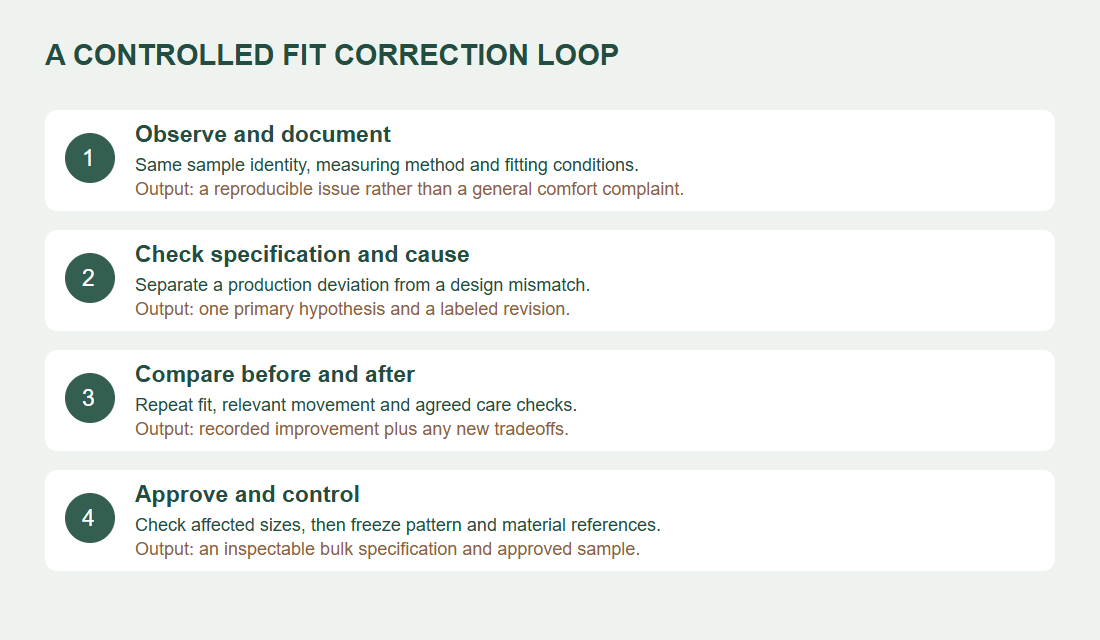
5. A six-step manufacturer and buyer correction process
- Define the intended fit range.
Record body measurements, relevant proportions, size chart, coverage, intended use and care requirements. Distinguish body measurements from finished garment measurements. A pregnancy-stage label alone is not a measurement specification.
- Reproduce and describe the issue.
Use consenting adult fit participants representative of the intended range and a suitable agreed fitting sequence. Record sample ID, size, body measurements, material reference, task, issue location and wearer feedback. Clothing fit evaluation does not establish medical suitability for activity.
- Check the sample against its specification.
Measure at agreed points under consistent conditions. Confirm fabric identity, grain/stretch direction, elastic, stitch construction and assembly. Determine whether the sample departed from the specification before redesigning the approved pattern.
- Choose one primary hypothesis.
Identify a likely driver, such as front panel contour or seam extension. Make a controlled revision and record what changed. If several changes are necessary, label each so the comparison remains interpretable.
- Compare, wash and check representative sizes.
Review the revised and previous samples under the same conditions, then repeat relevant checks after agreed care. Evaluate the size range and body proportions affected by the revision. A base-size improvement does not validate the entire grade.
- Freeze the approved reference.
Approve the pattern revision, bill of materials, measurement points, tolerances, seam details and sample. Define inspection sampling and the response to a failed check before production. Revisit affected approvals if a key material or construction changes.
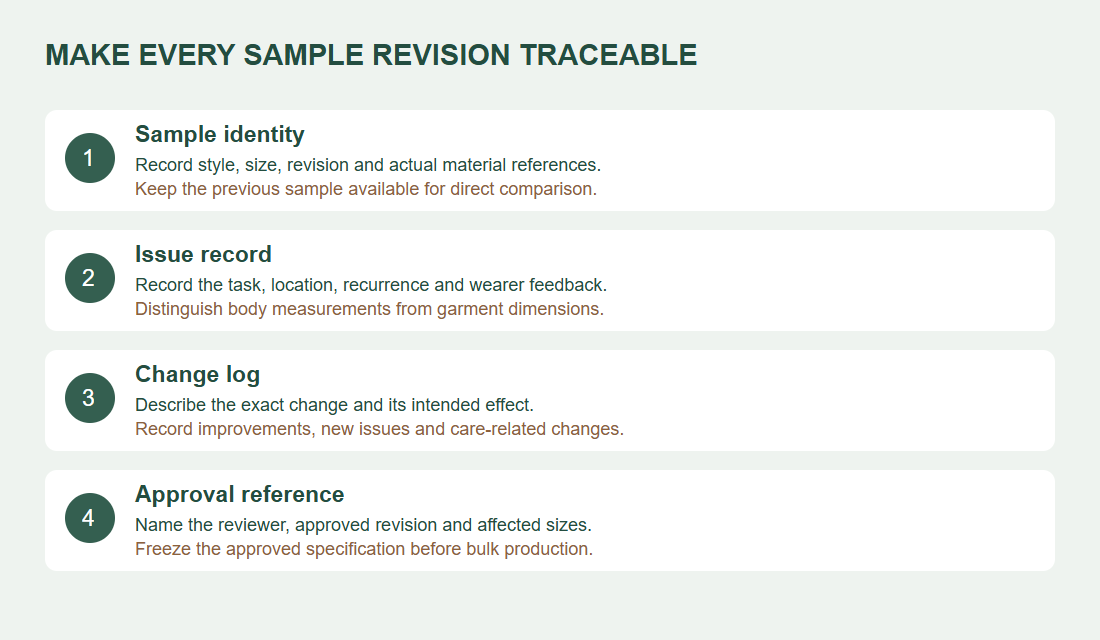
6. Use a fit correction record that supports decisions
| Record field | What to enter | Why it matters |
|---|---|---|
| Issue and trigger | For example: front edge folds after sitting; adjustment required | Prevents vague instructions such as “make more comfortable” |
| Sample identity | Style, size, revision, material and elastic references | Keeps comparisons traceable |
| Body and garment measures | Relevant dimensions and the measuring method | Separates fit-range mismatch from assembly variation |
| Change and hypothesis | Exact change and expected effect | Makes the revision reviewable |
| Results and tradeoffs | Location, recurrence, feedback, care effects and new issues | Avoids approving one improvement while overlooking another |
| Approval | Named reviewer, revision, affected sizes and open actions | Prevents an unapproved sample becoming the bulk reference |
Acceptance criteria should be agreed for the specific product. Do not invent a universal allowable waistband migration, abdominal pressure or number of wash cycles. A visual fit record, a dimensional inspection and a laboratory material test answer different questions; use each where it is relevant.
7. What affects correction costs and lead time?
The cost of a fit correction depends on where the problem originates and when it is found. Adjusting a development pattern is a different task from replacing a material already ordered for bulk production. Request a revision quotation that separates pattern work, samples, fabric minimums, trims, testing and delivery. A low unit price does not capture repeated development rounds or unusable inventory.
| Change | Potential cost or schedule effect | How to plan |
|---|---|---|
| Pattern contour or length | New cutting and sample assembly; affected grades may need revision | Review the base size before extending the change across the range |
| Panel fabric or elastic | Sourcing, minimums, color matching and renewed checks | Confirm availability before approving the replacement |
| Seam or finish | Trial sewing, settings and possible material changes | Check both comfort and construction on the new sample |
| Additional colors or sizes | More samples and approval work | Prioritize cases likely to expose fit or coverage differences |
| Post-approval change | Potential rework and disruption to committed materials or capacity | Require a written change assessment before proceeding |
Ohsure’s supplied fact library gives a starting MOQ of 100 pieces per style per color, with mixed sizes available. Final order requirements are subject to project confirmation; the figure is not a total allowance across unrelated styles and colors. Material or trim minimums should be confirmed separately.
Sample timing is confirmed after reviewing the design, materials and customization requirements. Bulk-production timing is confirmed according to the approved specifications, material availability and production schedule. Plan separately for sample development, buyer review, revisions, care checks, approval and production rather than treating one published factory duration as the complete launch calendar.
8. Common mistakes that create repeated fit rounds
- Sizing up every dimension. This can add loose fabric at the seat or back while leaving the front-length problem unresolved.
- Tightening the waistband first. Check downward pull, pattern balance and recovery before increasing edge tension.
- Approving by photographs alone. Record sitting, adjustment and wearer feedback as well as appearance.
- Using composition as a performance guarantee. Compare actual fabric references and finished garments rather than assuming all blends behave alike.
- Changing several variables without records. Keep a revision log and identify which effect each change is meant to address.
- Skipping care and size checks. Recheck affected properties after the agreed care procedure and across representative sizes.
- Promising one fit for every stage and body. Describe the measured accommodation range supported by the product’s evaluation.
9. Manufacturer perspective: turn feedback into an inspectable brief
Ohsurewear is based in Dongguan, Guangdong, and offers OEM, ODM and private-label activewear, including maternity and nursing garments. The supplied fact library describes design-reference review, sample development, materials discussion, garment manufacturing and packaging customization. Its maternity activewear manufacturing service is a relevant starting point for this category.
A useful manufacturing lesson is to replace “the waist feels wrong” with a documented issue: which edge, which task, which sample revision and which body measurements. Send the current tech pack, marked photographs, sample references and a prioritized correction list. Ask the manufacturer to explain the proposed pattern, material or construction change before approving it. This is practical development guidance, not a claim that Ohsure has completed a particular clinical study or measured fit trial.
The fact library describes four quality-control stages: raw materials, printing, semi-finished sampling and finished garments. For a fit-sensitive style, translate the approved development decisions into inspection items such as panel dimensions, seam construction, stitching and accessories. Agree tolerances and sampling rules for the order. Routine dimensional checks help control consistency; they do not replace initial wearer fit evaluation.
10. Frequently asked questions
Why do maternity leggings keep falling down?
Possible causes include waist geometry, material recovery, rise balance and downward pull from the legs or pockets. Check whether the whole garment migrates and compare loaded and unloaded pockets before changing elastic.
Should a rolling waistband be made tighter?
Only if the evidence supports that change. Rolling may also involve excess height, contour, seam bulk or panel/body tension. Compare a defined revision and assess whether it introduces edge discomfort.
Can a manufacturer solve fit by changing fabric alone?
Sometimes a material change addresses recovery or coverage, but it may also change the required pattern allowance and seam behavior. Review the revised fabric and pattern as an assembled garment.
Why does a maternity top ride up despite having enough stretch?
Stretch around the body does not automatically provide enough front length or appropriate shaping. Check front/back balance, hem restriction and the intended coverage range.
Does a successful base-size sample validate all sizes?
No. Review affected grades and representative body proportions. State the fit range that was evaluated rather than assuming one sample supports every size or pregnancy stage.
How many sample rounds should a brand budget?
There is no fixed number supported for every design. Ask for a plan covering initial development, prioritized revisions, relevant care checks and size review. Confirm the time and cost of additional rounds with the manufacturer.
Are maternity leggings medical support garments?
An ordinary maternity activewear fit specification describes coverage, comfort and garment behavior. It does not establish therapeutic benefit or a medical compression level.
What should I send Ohsure for a fit correction quote?
Send the style and revision, body and garment size charts, material references, issue record, photographs or a physical sample, intended quantities per style/color, branding, packing and approval requirements. Identify open decisions clearly.
11. Build a better maternity sample brief
Explore the custom maternity and nursing activewear product collection to define the garment category. Discuss category-specific development through the maternity manufacturing service, or use the custom activewear OEM/ODM service for a coordinated range.
For the next sample request, name the three most important fit issues, provide the current specification and agree how each revision will be evaluated. Approve the corrected pattern, actual materials and construction together before authorizing bulk production.
Sources and editorial scope
Company information follows the buyer-supplied Ohsure article fact library. Related official pages: company profile, maternity manufacturing and custom manufacturing. The comparison tables, diagrams and correction workflow are editorial garment-development guidance, not reported test results, a verified factory case study or medical advice.