Custom Leggings Manufacturing Guide: Fabric, Fit and Construction
- Share
- publisher
- Ohsure
- Issue Time
- Nov 5,2026
Summary
Develop custom leggings with practical fabric comparisons, fit and construction checks, sample approval steps, MOQ planning and a buyer-ready specification checklist.
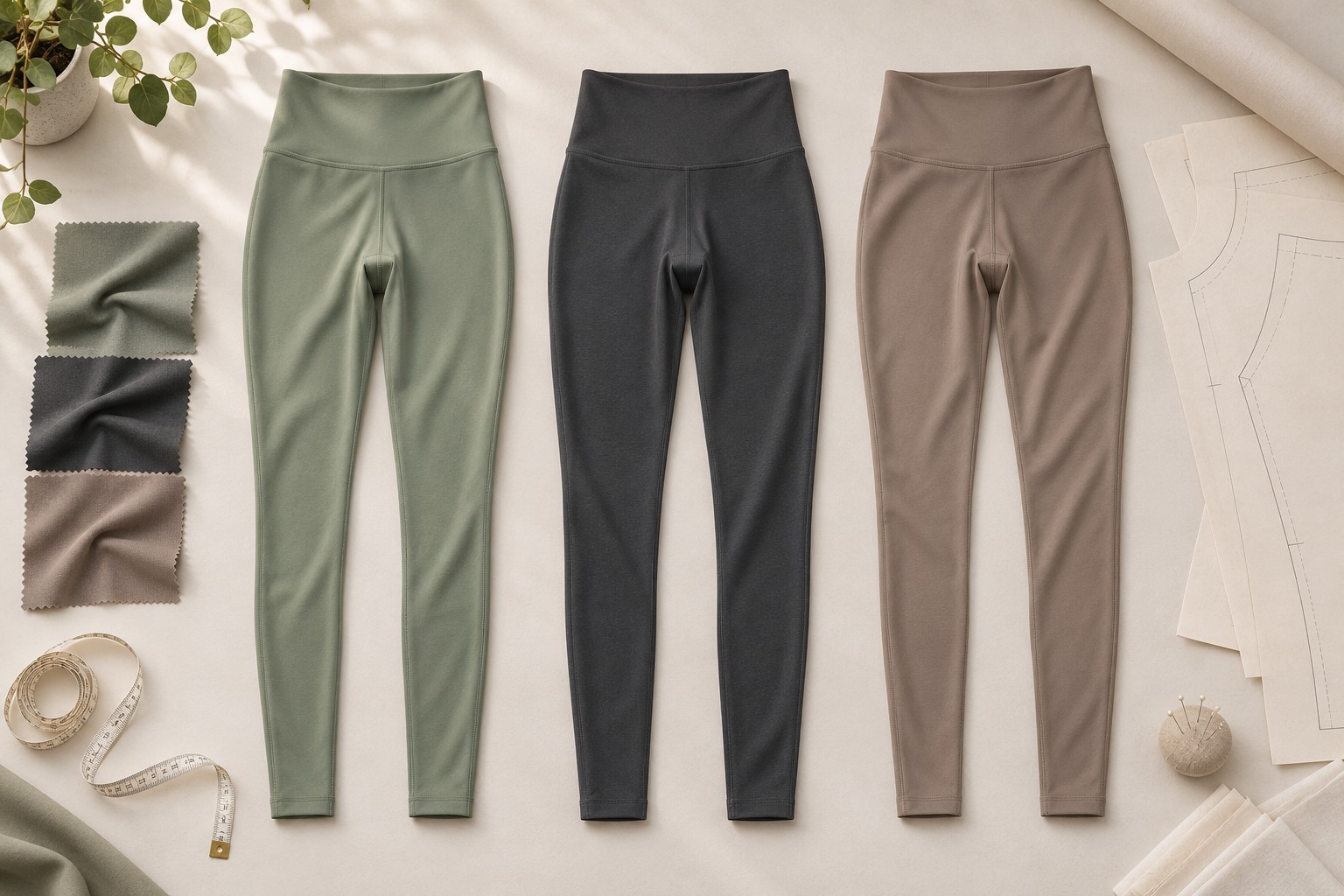
Turn a leggings concept into a specification your sample room and production team can follow.
For activewear brands, product developers and sourcing teams
Custom leggings manufacturing combines stretch fabric, a graded pattern, waistband design, gusset construction and seam choices into an approved garment. Start with the intended activity and customer fit, then compare materials in finished samples. Confirm coverage, recovery, measurements, comfort and wash behaviour before approving bulk production, branding, quantities and delivery milestones.
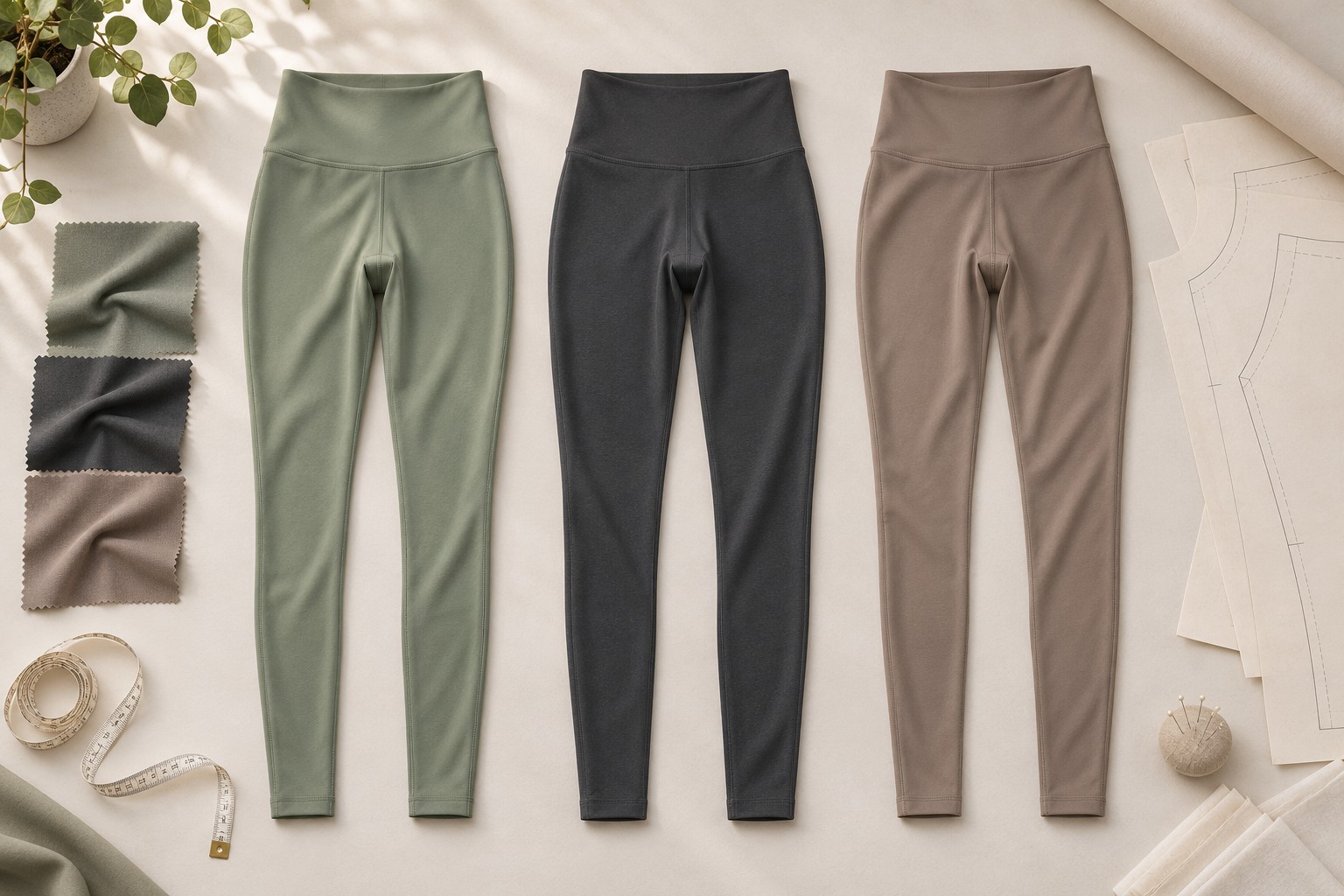
What is custom leggings manufacturing?
Custom leggings manufacturing is the development and production of close-fitting stretch trousers to a buyer’s agreed requirements. The work connects the intended wearer and activity with fabric, pattern shape, assembly, branding and order quantities. A photograph can show the look; it cannot specify stretch behaviour, size grading or the tolerances used to accept bulk garments.
A tech pack is the controlled product file containing drawings, materials, measurements, construction and artwork. Grading defines pattern changes between sizes. Recovery describes how a stretched material returns toward its original dimensions under defined conditions. Negative ease means that a garment dimension is smaller than the corresponding body dimension, so the fabric stretches during wear. The appropriate amount depends on the complete fabric-and-pattern combination.
Define the product’s main job first: studio movement, gym training, running or everyday wear. Then rank the priorities—coverage, waistband security, freedom of movement, storage and handfeel. This gives the manufacturer a basis for proposing materials and construction, rather than guessing what “premium leggings” means.
Explore Ohsure’s custom gym leggings range for silhouettes, and use the custom leggings manufacturing service to discuss the development scope.
Compare fabrics in the garment, not only on the swatch card
Request a fabric code, composition, knit construction, finished weight, usable width, finish and colour reference. GSM means grams per square metre: it tells you fabric mass per area, not whether a finished legging will stay opaque, resist pilling or feel comfortable during exercise.
| Candidate | Development question | Approval checks |
|---|---|---|
| Nylon/spandex | Does this particular knit deliver the intended surface feel and close fit? | Movement coverage, recovery, surface abrasion, wash behaviour and logo compatibility |
| Polyester/spandex | Does the material suit the intended training garment and any planned print? | Handfeel, stretch balance, print-process compatibility, colourfastness and post-wash dimensions |
| Recycled nylon or polyester blends | Can the material meet both the garment brief and the documented sourcing claim? | Composition, traceability, supporting documents and the same fit/performance checks as other candidates |
| Cotton-containing stretch knits | Does a lifestyle-oriented concept need a different balance of feel and shape retention? | Recovery after wear, shrinkage, surface changes and suitability for the intended activity |
These are candidate directions, not performance rankings. Ohsure lists multiple material families in its supplied fact library; the exact composition, weight, finish and colour require project confirmation. Its activewear fabric guide is a starting point for sourcing discussions.
Specify coverage and recovery as checks
For coverage, agree the sizes, colourways, lighting and movements used in review. Include bending and squatting where relevant, and check the lightest intended colour. Record the review conditions and approved reference. A black swatch held at rest cannot establish coverage for a light-coloured legging stretched across the hip.
For stretch and recovery, ask which method, fabric direction, load or extension, hold time and recovery interval will be used. Compare results produced under the same conditions. A higher spandex percentage alone does not establish stronger compression or better recovery; yarns, knit structure, finishing and garment dimensions also affect the result.
If moisture management, drying speed, abrasion resistance or quantified compression will be claimed in marketing, agree relevant testing and obtain evidence for the exact material or garment. Keep fabric sourcing attributes and measured performance as separate approval items.
Build the fit around your customer and size range
Use a target body-size chart and a separate finished-garment measurement chart. Label every dimension as a flat width, circumference or length, and state whether the garment is relaxed or measured under a defined stretch condition. Confusing a flat waist width with waist circumference can invalidate an entire comparison.
Record waist, hip, thigh, front rise, back rise, inseam, leg opening and waistband height with illustrated measurement points. Where gusset construction interrupts a seam, define exactly where the measurement starts and ends. Set tolerances point by point after development review rather than applying one arbitrary number to every dimension.
Approve grading beyond the base size
A successful medium sample does not establish fit across the collection. Review representative sizes, especially the ends of the intended range, and check whether rise, waistband position, gusset placement and pocket access still work. Increasing every dimension by the same amount is not a substitute for a considered grading rule.
Use a repeatable wear-review sequence: stand, sit, walk, bend and perform the intended activity. Log waistband movement, pressure points, crotch comfort, seam irritation and any fabric bagging. Recheck after care according to the agreed protocol. Use consented fit-review images and link observations to the sample revision and size.
Choose waistband, gusset and seams as a system
Construction decisions change how the fabric and fit behave together. Ask the sample room to propose stitch and seam specifications for each location, including thread, seam allowance, reinforcement and finishing. A decorative seam name does not prove stretch compatibility or comfort.
| Feature | Options to discuss | What to check in samples |
|---|---|---|
| Waistband | Folded or shaped band; self fabric or separate lining; elastic where appropriate | Height, contour, edge pressure, rolling and slipping during movement |
| Gusset | Shape, dimensions, orientation and seam junction position | Comfort, movement, bulk and stress at joining points |
| Front and back seams | Front seam, no-front-seam pattern, back shaping or scrunch detail | Crotch fit, seam placement, comfort and repeatability across sizes |
| Joining and finishing | Appropriate overlock, flatseam or coverstitch applications | Seam extension, bulk, skipped stitches, puckering and rubbing |
| Side pocket, waistband pocket or no storage | Opening access, reinforcement and garment movement with a representative load | |
| Hem and branding | Hem finish; logo method, size and placement | Ankle comfort, seam extension, artwork distortion and appearance after care |
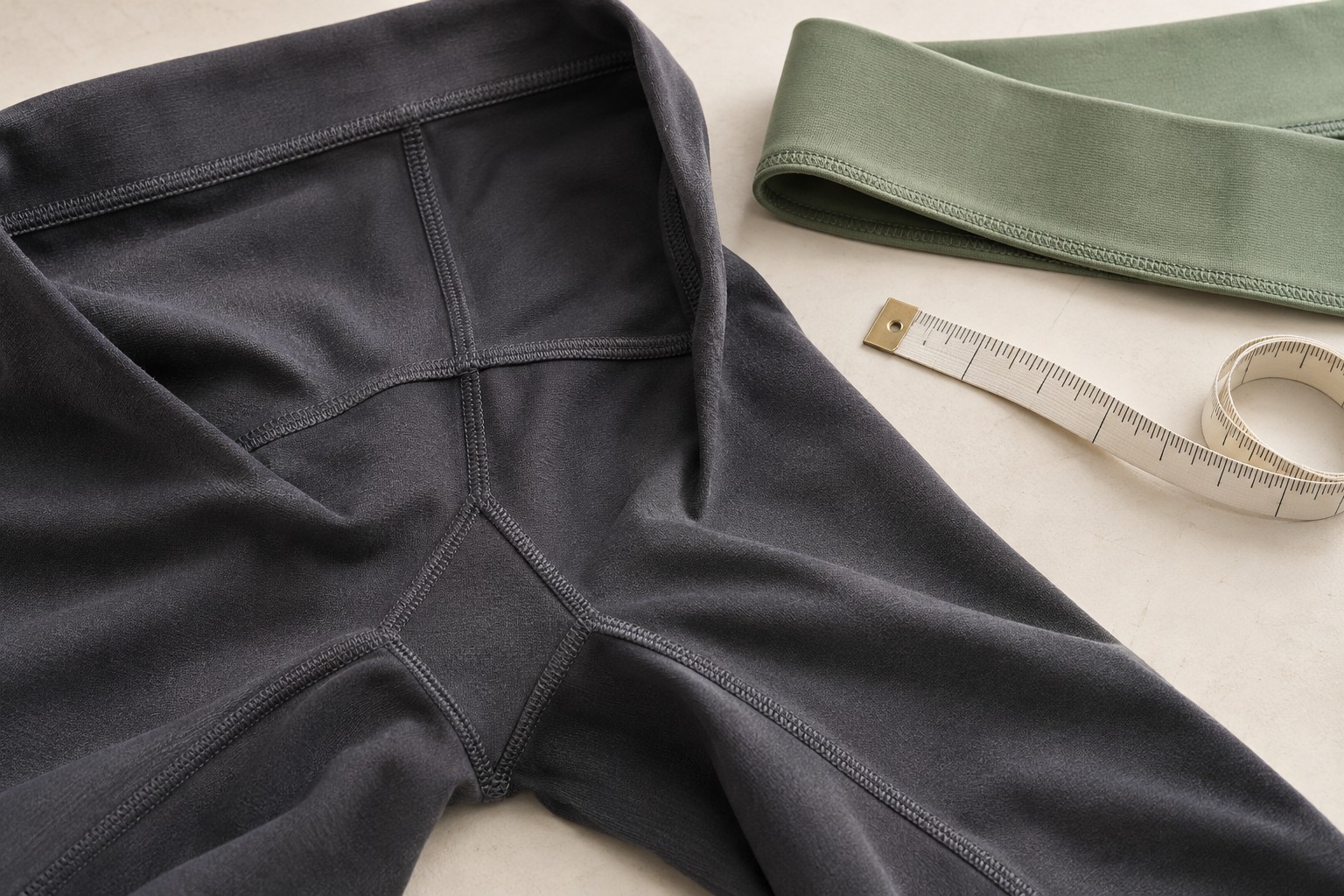
Cut-and-sew, seamless and no-front-seam are different decisions
Cut-and-sew leggings are assembled from cut fabric panels, allowing the pattern and seam placement to shape the garment. A knitting-led seamless route builds much of the shape and surface structure during knitting, but may still need joining or finishing seams. No-front-seam simply describes one design feature; it can be achieved in a cut-and-sew garment.
Compare the routes for the desired silhouette, surface design, material options, grading, development needs and production minimums. Confirm project capability and availability with the supplier. Neither route removes the need to approve comfort, coverage and size consistency.
Seven steps from brief to bulk approval
The following is a recommended buyer workflow. Agree responsibilities and sign-offs with the manufacturer before development begins.
Write the product brief
State the customer, activity, silhouette, size range, target retail position and essential features. Attach drawings or a permitted reference sample. Mark which details are fixed and which the development team may propose.
Shortlist materials and the construction route
Compare identified swatches, confirm sourcing minimums and choose a route suited to the design. Record the intended colour and finish. Ask for alternatives before committing to a material that creates an unsuitable minimum or schedule.
Prepare the first sample specification
Issue the point-of-measure chart, construction drawings, bill of materials and artwork. Identify any temporary substitute used in the sample. Such substitutions must be resolved before final approval.
Review fit and movement
Measure the sample and complete the same wear-review sequence each round. Consolidate comments into one revision file with photos, affected measurement points and required changes. Avoid conflicting instructions across messages.
Check care behaviour and representative sizes
Review the agreed care protocol, dimensional changes, shade, surface appearance and seam condition. Check selected sizes and relevant colourways. Agree methods and acceptance limits; a casual wear trial is not a laboratory report.
Freeze the production reference
Approve the dated sample, materials, colour references, grading, artwork and packaging together. Confirm that the pre-production sample represents intended bulk components. Require written reapproval for significant substitutions.
Release the order with a quality plan
Confirm quantities, inspection responsibilities, defect definitions, measurement tolerances, sampling arrangements and dated milestones. Request production evidence at agreed checkpoints and confirm packing and shipment arrangements separately.
Ready-to-send brief: “We are developing [activity] leggings for [customer], sizes [range], with [rise/inseam], [waistband], [gusset/pockets] and [branding]. Please quote [quantity per style/colour], identify proposed materials and minimums, and list development fees, sample deliverables, approval milestones and unresolved assumptions.”
What changes leggings manufacturing cost and lead time?
A useful quotation separates development charges from repeatable garment costs. Pattern work, additional sample rounds, colour development and testing may create one-time costs. Fabric consumption, cutting efficiency, seam operations, pockets, branding, trims and packaging affect recurring cost. Ask what is included rather than comparing unit prices from different specifications.
| Driver | Why it matters | Buyer action |
|---|---|---|
| Fabric and colour | Custom sourcing or dyeing can add minimums and approval stages | Confirm stock versus custom supply, lot requirements and colour approval |
| Pattern and fit revisions | Each unresolved fit issue can require another sample cycle | Consolidate feedback and agree what each development fee includes |
| Added construction | Pockets, extra panels and special finishes add materials or operations | Ask for optional features to be priced separately |
| Branding and packaging | Setup, artwork approval and accessory minimums may affect cost | Confirm method, dimensions, quantities and mock-up approval |
| Testing and inspection | Scope and acceptance requirements affect work and booking needs | Agree methods, responsibilities, reports and costs before order release |
| Freight and destination | Shipping and destination charges change the delivery budget | Request the quoted shipping scope, exclusions and estimated transit separately |
MOQ example—not a quotation: one leggings style in three colours at 100 pieces per colour means 300 garments. An illustrative size split of 20 S + 40 M + 30 L + 10 XL totals 100 per colour. Adding a second separately counted style in the same three colours would bring the plan to 600 garments under the same assumption.
Ohsure’s published starting MOQ is 100 pieces per style per colour, with mixed sizes available. Final order requirements are subject to project confirmation. Ask whether design changes create a new style and whether fabric, custom colours, labels or packaging have separate minimums.
Illustrative cost calculation: if development costs were $240 and 300 approved garments were produced, the allocated development cost would be $0.80 per garment ($240 ÷ 300). These are teaching figures, not Ohsure prices. Recalculate for the actual order and add the quoted garment, packing, testing and delivery costs as applicable.
Schedule the approval chain: brief review → material/colour approval → sample and revisions → final specification approval → bulk production → inspection/packing → shipment. Ask which activities can overlap and what starts each clock. Sample timing is confirmed after reviewing the design, materials and customisation requirements. Bulk-production timing is confirmed according to approved specifications, material availability and the production schedule. Keep buyer approval time and transit time visible in the launch plan.
Common mistakes—and how to correct them
- Choosing fabric from composition alone. Review the identified knit in the actual fit and planned colours, including after care.
- Using tightness as the only fit criterion. Check movement, pressure points, coverage and waistband behaviour together.
- Solving every waistband problem by reducing its width. Review rise, contour, recovery, band structure and pocket load before revising.
- Approving one size for the full range. Review grading and representative sizes before bulk release.
- Calling a style squat-proof, compressive or certified without evidence. Define the claim and its supporting checks or documents for the actual product.
- Letting sample comments become separate instructions. Maintain one dated tech pack, consolidated comment log and approved sample reference.
- Comparing prices without matching scope. Align fabric, construction, quantities, development deliverables and delivery inclusions first.
A manufacturer’s perspective: approve the combination
Ohsure’s supplied fact library describes a Dongguan-based manufacturer offering OEM, ODM and private-label development, with sample-room and pattern-design support. Its published services include labels, logos, hangtags and packaging. Discuss who will prepare each technical document through the OEM/ODM service and private-label service.
The practical manufacturing lesson is to approve the material, pattern and assembly together. When a fit problem appears, keep the other variables controlled while testing a change. If fabric and waistband shape both change between rounds, it becomes difficult to identify which revision improved the garment. This is development guidance, not a claim about a recorded Ohsure customer case.
Ohsure’s quality-control page describes raw-material, printing-process, semi-finished and finished-garment checks. For a leggings order, turn those categories into a project-specific inspection plan covering the agreed measurements, seams, shade, branding and accessories. Request the applicable methods, tolerances and sampling rules; a published inspection description alone does not establish an independent test result or universal acceptance standard.
To begin a focused discussion, send your brief with a shortlist from the leggings product collection. Identify the desired details and ask the team to confirm what can be developed for your quantity and schedule.
Custom leggings manufacturing FAQ
What is the best fabric for custom leggings?
Choose fabric for the intended activity and fit. Nylon/spandex and polyester/spandex are useful candidates, but composition alone cannot establish coverage, recovery or comfort. Approve an identified fabric in the actual garment, including the planned colours and size range.
Does a higher GSM make leggings squat-proof?
No. GSM measures fabric mass per area. Coverage also depends on knit structure, colour, finishing and how far the garment stretches on the wearer. Agree movement and lighting conditions and review finished samples before making a coverage claim.
Are no-front-seam leggings the same as seamless leggings?
No. No-front-seam describes the removal of a particular front joining seam. A garment can still have a back seam, inseams and waistband seams. Seamless refers to a knitting-led construction route, which can also require joining and finishing seams.
How can I reduce waistband rolling or slipping?
Review rise, waistband height, shape, material recovery and any elastic together. Check the garment during movement and sitting, including with loaded pockets. Identify the cause through controlled sample revisions; simply tightening the waist may create discomfort without solving the issue.
What is Ohsure’s MOQ for custom leggings?
MOQ starts at 100 pieces per style per colour, with mixed sizes available. Final order requirements are subject to project confirmation. Confirm how styles are counted and whether custom fabric, colours, labels or packaging have separate minimums.
How long do leggings sampling and production take?
Sample timing is confirmed after reviewing the design, materials and customisation requirements. Bulk-production timing is confirmed according to approved specifications, material availability and the production schedule. Ask for dated milestones, their starting conditions and separate shipping time.
Can recycled fabric be used for leggings?
Recycled fabric options can be discussed, subject to project availability. Specify the exact composition and obtain evidence for any recycled-content or certification statement. Evaluate fit and garment behaviour separately; the recycled attribute does not establish performance.
What should be approved before bulk cutting?
Approve the material and colour references, fit and size grading, point-of-measure chart and tolerances, construction details, artwork, labels, care instructions, packaging and quality plan. Link everything to one dated sample revision and require written approval for material changes.