Custom Sports Bra Manufacturing Guide: Support, Fit and Testing
- Share
- publisher
- Ohsure
- Issue Time
- Nov 6,2026
Summary
Plan custom sports bra support, sizing, materials and testing with construction comparisons, sample approval steps, MOQ examples and a practical review checklist.
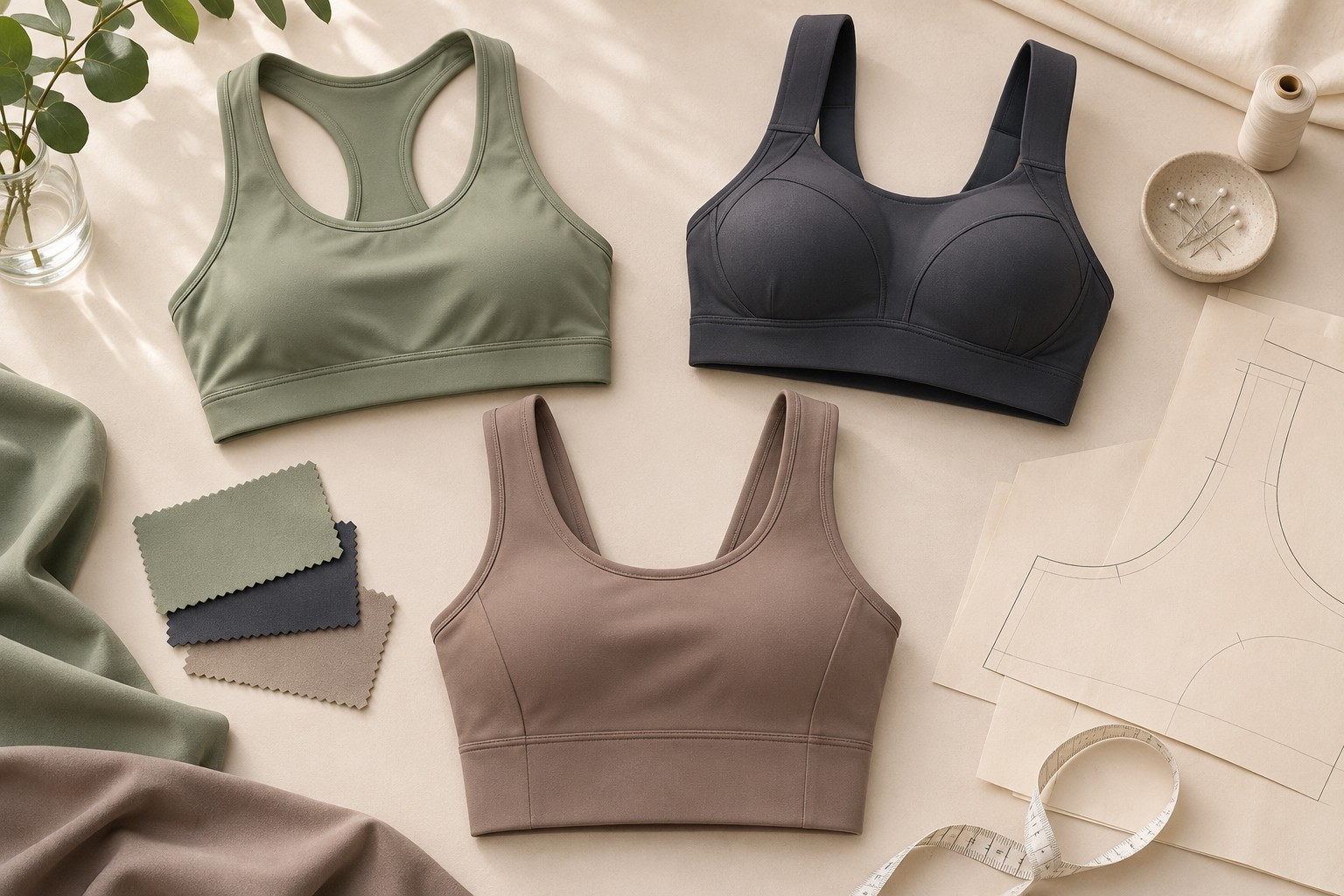
Specify support as a system, validate the size range, and give the sample room clear approval criteria.
For activewear brands, product developers and sourcing teams · Published 6 November 2026
Custom sports bra manufacturing turns an activity and size brief into an approved support system: cups, underband, straps, lining and stretch fabric working together. Define the intended wearer and movement, evaluate fit across representative sizes, and agree testing before bulk approval. Confirm materials, branding, quantities, quality criteria and delivery milestones in one controlled specification.
What is custom sports bra manufacturing?
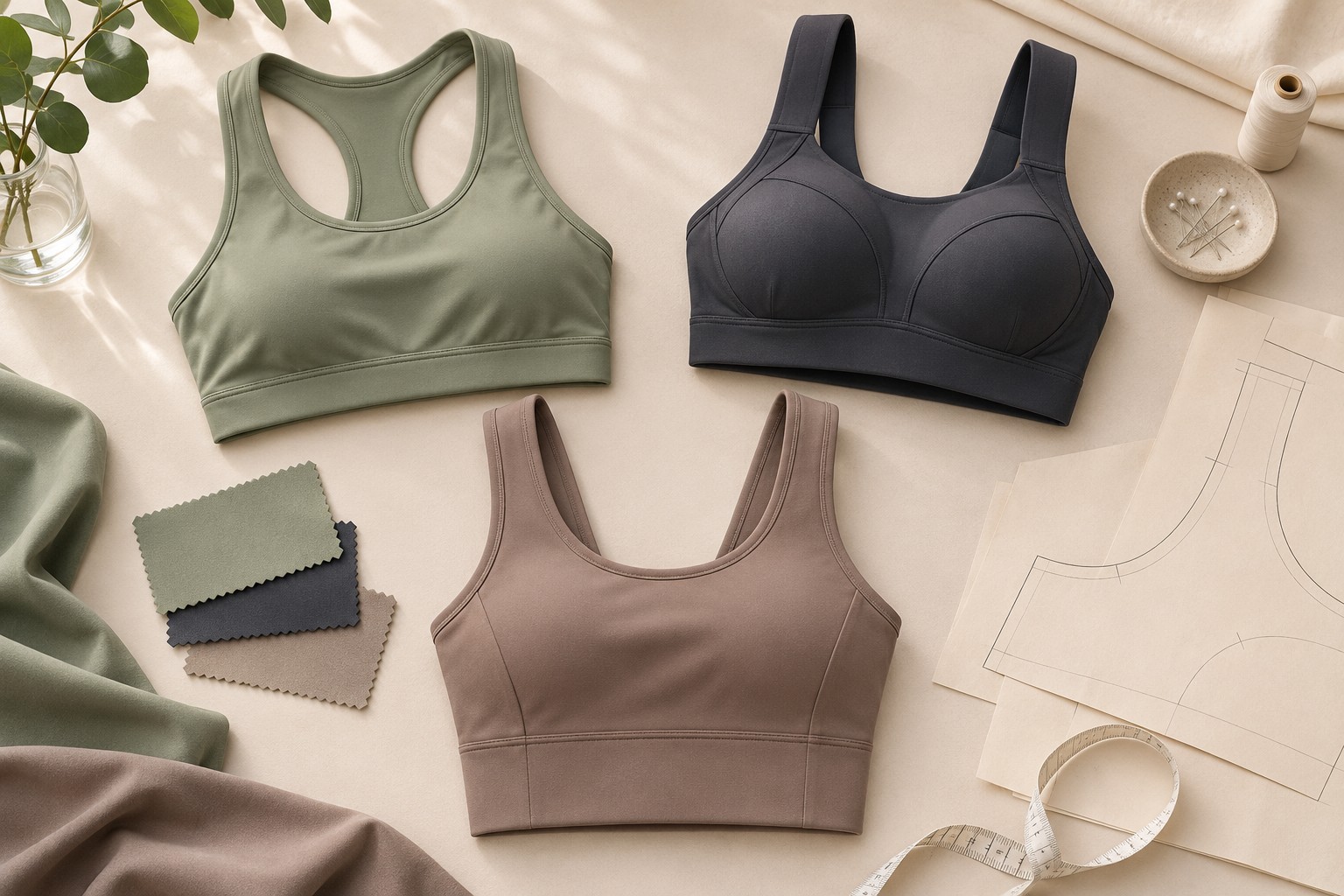
Custom sports bra manufacturing is the development and production of a breast-support garment to agreed buyer requirements. It connects the activity, intended body-size range and silhouette with the pattern, fabric, cups, elastic, straps, seams and branding. A reference photograph helps communicate appearance; a controlled specification defines what the manufacturer must reproduce.
Compression describes a construction approach that holds the breasts closer to the torso. Encapsulation uses shaped spaces that contain each breast separately. Combination construction brings both approaches into one garment. These terms describe design mechanisms, rather than verified performance grades.
Support concerns control of breast movement during the specified activity. Fit concerns how the garment accommodates the wearer’s dimensions and shape. Comfort includes the wearer’s experience of pressure, rubbing and ease of movement. Assess all three: a garment can feel tight without meeting its intended support or comfort brief.
Start with Ohsure’s custom sports bra product range for silhouette references, then use its sports bra manufacturing service to discuss the project specification.
Compare support structures before choosing a silhouette
Write the intended activity and wearer into the brief before assigning a support label. A studio-focused style and a running-focused style may need different coverage, adjustability, component choices and validation. Treat low, medium and high support as claims requiring a stated basis, rather than assuming that a racerback or a wide strap establishes a category.
| Approach | Development opportunity | Checks before approval |
|---|---|---|
| Compression-led pullover | A relatively simple silhouette with fewer closure components | Containment, underband position, pressure, ease of putting on and taking off, and fit across bust volumes |
| Encapsulation-led design | Separate cup shaping with scope to refine volume and coverage | Cup depth, upper and side containment, symmetry, seam position and grading between size combinations |
| Combination design | Use shaped containment together with a close-fitting outer structure | Whether layers and shaping improve the intended result without excessive pressure, bulk or heat |
| Adjustable straps or closure | Provide adjustment for the defined fitting range and dressing needs | Adjustment range, hardware security, skin contact, slippage and ease of operation |
These options are design directions to discuss with the sample room, not a ranking or a promise that every construction is available for every order. Confirm capability, components and minimums for the chosen project.
Specify every layer and component
A bill of materials should identify the outer fabric, lining, support layer if used, cup or pad, elastic, binding, thread, hardware, labels and logo method. For each fabric, record the code, composition, knit structure, weight, finish and colour reference. Where direction matters, show how the material is oriented in the pattern.
Ohsure’s fact library lists nylon/spandex and polyester/spandex among its material options. These are starting points for sourcing, not proof of support. Ask for stretch and recovery information under agreed conditions, and evaluate the selected combination in a finished sample. More spandex or a higher GSM does not by itself establish better support.
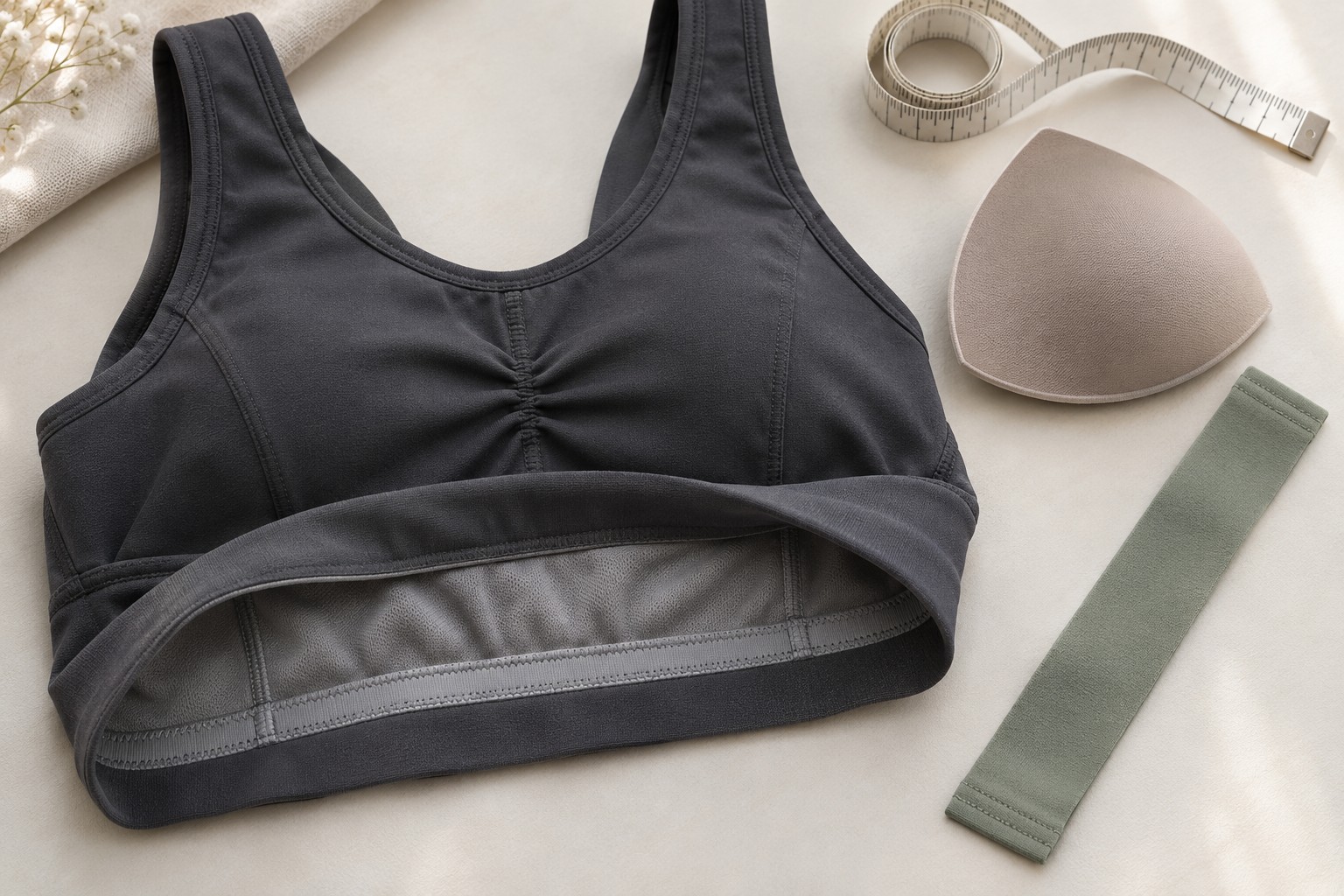
Removable pads can affect coverage and appearance; their pockets and openings also need specification. Check that pads do not fold, rotate or escape during the agreed wear and care review. Moulded cups introduce their own shape, tooling or sourcing questions. Confirm cup geometry and size availability before freezing the pattern.
Use Ohsure’s activewear fabric guide to frame sourcing questions. If a bra will coordinate with custom gym leggings, approve the colour pairing in the actual fabrics; matching colour names do not ensure matching shades.
Build the size system around underbust and bust variation
Keep the target body-size chart separate from the finished-garment measurement chart. Define the intended market’s sizing convention and explain whether the product uses alpha sizes, band-and-cup sizes or another system. Labels such as S, M and L are not sufficient instructions for cup volume or the intended fitting range.
Record underbust and full-bust ranges, the fit model information needed for development, and any shape or coverage priorities. Wearers with the same underbust can have different bust volumes. Review whether your intended size system needs more than one cup option within a band or alpha size. Avoid promising broad cup coverage without representative fitting evidence.
Make measurements repeatable
Illustrate the underband measurement, front and back length, cup or panel dimensions, neckline, armhole, strap width and strap-length setting. Label flat widths and circumferences clearly. State whether measurements are taken relaxed or under a defined extension. Set tolerances for individual points in agreement with the manufacturer.
Review the band for position and movement, the cups or front panel for containment and gaping, and straps for pressure and slippage. Check seam junctions, armholes, labels and hardware for rubbing. For wired designs, add wire position and clearance checks; a centre-front fitting rule used for a wired bra should not be copied indiscriminately onto a wireless crop silhouette.
Assess representative sizes and body shapes, including the edges of the intended range. Record donning and removal as well as movement: a secure pullover may still be difficult to remove after exercise. Change one clearly identified variable where possible, then compare the revised sample under the same conditions.
Separate quality checks from evidence for a support claim
A sensible testing plan has three layers: materials and components, the finished garment, and any specialist support evaluation needed for the claim. Passing a fabric test does not establish support in a bra. A favourable wearer comment does not establish a quantified movement-reduction result.
The University of Portsmouth’s Research Group in Breast Health describes specialist bra testing that measures breast movement in three directions and gathers wearer feedback. This illustrates why objective support assessment and subjective comfort feedback answer different questions. The source is a research reference; it does not establish that Ohsure products have undergone that testing.
| Evaluation layer | What to record | Approval evidence |
|---|---|---|
| Material and component checks | Identified fabric, lining, elastic and cup; agreed methods for recovery, colourfastness, shrinkage and other relevant properties | Reports or recorded checks tied to the actual material reference; limits and responsible party agreed in advance |
| Finished-garment fit and movement | Sample revision, size, wearer measurements, activity sequence, duration, band movement, containment and comfort | Dated fit review with observations, photos where consented, corrective action and re-review decision |
| Care and durability review | Care instructions, agreed cycle count, drying conditions, dimensions, pad position, seams, hardware and branding before and after care | Before/after records against agreed limits; results apply to the reviewed sample and conditions |
| Specialist support evaluation | Test population and fit, activity, equipment, baseline where relevant, outcomes and claim scope | A suitable report for the exact product and claim; do not generalise beyond its tested scope |
A repeatable sample-room movement review
Agree a sequence relevant to the product, such as walking, reaching, bending and the intended exercise. Record the same observations for each sample revision. Let wearers flag unacceptable pressure or discomfort and stop the session where necessary. The sequence is a development screen; it should not be presented as an accredited support certification.
For a percentage movement-reduction claim, ask the testing provider how the baseline, movement direction and calculation are defined. For a “high support” label, establish the classification basis and product coverage before printing packaging. Do not infer a universal support threshold from a competitor’s label.
Define the decision rule in advance. For example, the buyer might require a documented resolution of every observed band-roll or cup-gaping issue before approval, while agreeing separate numerical tolerances for measurements. These are project choices, not published Ohsure acceptance standards. Keep functional approval and bulk inspection sampling as separate decisions.
Use the sports bra sample-review checklist below to record the revision, review conditions, result, owner and corrective action.
Sports bra sample-review checklist
For each item below, record the agreed method and conditions, result or evidence, responsible person, corrective action and status or date. Tie every review to the same sample revision.
| Area | Information to record |
|---|---|
| Brief | Intended activity and support claim |
| Identity | Sample revision, date, size and colour |
| Wearer | Consented participant ID and relevant body measurements |
| Band | Position, rolling, pressure and movement |
| Cups/front panel | Containment, gaping, volume and coverage |
| Straps | Setting, slippage, pressure and adjustment |
| Dressing | Putting on, removing and operating closure |
| Movement | Agreed sequence, duration and observations |
| Care | Method, cycle count, drying and before/after dimensions |
| Components | Pads, seams, hardware and logo condition |
| Evidence | Required report and exact claim scope |
| Approval | Open issues, corrective action and re-review decision |
Seven steps from the first brief to bulk release
This is a recommended buyer workflow, organised around Ohsure’s advertised development and manufacturing services. Confirm the responsibilities and sign-offs for your project.
Define the intended product
Specify activity, wearer, size range, support objective, silhouette, coverage and retail position. Include reference drawings or an authorised reference garment. Separate essential requirements from features open to proposal.
Agree the size and material strategy
Choose the body-size framework, shortlist construction routes and identify candidate materials and components. Confirm component availability and any minimums before investing in a pattern built around them.
Issue a controlled first-sample file
Provide drawings, measurement points, bill of materials, seam details, cup or pad requirements, artwork and adjustment settings. Mark substitute components clearly so a development sample cannot be mistaken for the bulk reference.
Review fit and movement
Evaluate representative wearers and sizes using the agreed sequence. Consolidate comments into one revision document with annotated photos and specific changes. Resolve cup fit, band behaviour and strap problems together.
Complete the agreed validation
Review care behaviour and required material checks, plus specialist support testing where needed. If results prompt a change to the fabric, cup, elastic or pattern, assess which earlier checks must be repeated.
Approve the production reference
Freeze the sample revision, materials, size grading, colour, artwork, care instructions and packaging. Require written approval for significant substitutions and identify the reference retained by each party.
Release bulk with a quality plan
Confirm quantities, defect definitions, measurement tolerances, inspection scope and sampling arrangements. Agree progress evidence, packing, shipping responsibilities and dated milestones before production begins.
What affects cost, MOQ and lead time?
Compare quotations against the same specification. Separate pattern and development charges from repeat garment costs. A complex cup system, extra support layer, adjustable hardware or multiple fit variants can change both development work and recurring cost. Ask suppliers to price optional features separately so each design decision has a visible consequence.
| Driver | Possible consequence | Question for the manufacturer |
|---|---|---|
| Cup, elastic and hardware sourcing | Additional component minimums, colour matching or approval stages | Are these standard components? What changes with each size or colour? |
| Fit variants and sample rounds | More patterns, reviews and revisions | Which sample rounds, sizes and revisions are included in the fee? |
| Validation scope | Laboratory booking, sample consumption and re-testing | Who arranges each check, pays the cost and approves the report? |
| Branding and packaging | Setup charges and accessory minimums | What are the method, artwork, quantity and approval requirements? |
| Bulk and shipment planning | Material availability, production slots and transit affect launch timing | What starts each stage, what is excluded, and when is delivery estimated? |
MOQ calculation: Ohsure’s published starting point is 100 pieces per style per colour, with mixed sizes available. One style in three colours therefore means 300 pieces under that starting assumption. An illustrative split of 20 S + 40 M + 30 L + 10 XL totals 100 for each colour. Confirm whether a separate cup option counts as another style and whether components have separate minimums.
Illustrative development allocation: if development cost were $360 for 300 garments, it would add $1.20 per garment ($360 ÷ 300). These are teaching figures, not Ohsure prices. Add actual garment, packaging, testing and delivery costs according to the quotation.
Final order requirements are subject to project confirmation. Sample timing is confirmed after reviewing the design, materials and customisation requirements. Bulk-production timing is confirmed according to approved specifications, material availability and the production schedule.
Build the launch plan around dependencies: component availability → sample and revisions → validation → final approval → bulk production → inspection and packing → shipment. Buyer response time, failed checks and transit can extend the calendar beyond the quoted production stage. Request milestone dates and the conditions that make them valid.
Common mistakes that weaken a sports bra brief
- Equating thick padding with high support. Evaluate the full band, cup, strap and material system during the intended activity.
- Making the band tighter to fix every fit issue. Review cup volume, pattern balance, elastic behaviour and strap settings before revising.
- Approving only a medium sample. Check representative sizes and bust volumes within the intended fit range.
- Changing several materials after testing. Track substitutions and determine which fit, care or support checks need repeating.
- Ignoring dressing and pad retention. Include removal, closure use and laundering in the sample review.
- Treating an in-house wear trial as certification. Describe the actual method and keep claims within the available evidence.
- Leaving measurement conditions undefined. Distinguish relaxed measurements from measurements under extension, and specify strap settings.
- Comparing quotes with different inclusions. Reconcile materials, sample scope, testing, branding, packaging and delivery terms.
Ohsure’s manufacturing perspective: turn observations into specifications
The supplied Ohsure fact library describes a Dongguan-based activewear manufacturer offering OEM, ODM and private-label projects, with sample development, pattern support and custom branding. For a sports bra project, buyers can make that support more useful by submitting one coherent file containing the intended activity, body-size chart, measurements, construction references and component requirements.
Ohsure’s quality-control page describes raw-material checks, printing-process inspection, semi-finished sampling and finished-garment inspection. Its fact library also identifies checks involving fabric and garment properties. Confirm the methods, sampling rules, tolerances and reports applicable to your order; these descriptions do not establish a sports bra support rating.
Practical development example: if a wearer reports that the band moves upward during arm raises, log the size, body measurements, sample revision, strap setting and movement conditions. Ask the development team to review the pattern and components, issue a documented revision, and repeat the same review. This is an illustrative problem-solving workflow, not a claimed Ohsure customer case.
Ready-to-send enquiry: “We are developing a sports bra for [activity] and [wearer range], in [size system], with [support objective], [cup/pad construction], [strap/closure] and [branding]. Please propose materials and components, identify minimums, quote development and bulk separately, and confirm fit-review deliverables, testing responsibilities and approval milestones.”
Discuss the project through Ohsure’s custom activewear development service. An effective first discussion ends with written assumptions and open decisions, followed by a sample plan that both parties can evaluate.
Custom sports bra manufacturing FAQ
What makes a sports bra high support?
Support is a property of the complete garment on a particular wearer during a defined activity. Cup design, underband, straps, coverage, materials and fit interact. Agree the intended size range and an evaluation protocol before using a high-support claim; padding thickness alone does not establish it.
Is compression or encapsulation better?
Neither construction is universally better. Compression holds the breasts closer to the torso, while encapsulation uses shaped spaces for each breast. A combination can use both approaches. Compare finished samples for your intended wearers, activities, comfort and ease of dressing.
Can one S–XL size chart fit every cup size?
An alpha size chart needs a defined body-measurement range and fit evidence. Wearers with similar underbust measurements can have different bust volumes and shapes. Consider separate cup options or a narrower stated fit range when one alpha size cannot meet the brief.
Do removable pads provide the same function as shaped cups?
Removable pads may change coverage, appearance and feel. A shaped cup is part of the garment geometry. Neither feature alone proves support. Check pad retention, cup volume, edge visibility, laundering and movement in the completed garment.
Which tests should be agreed before production?
Separate material and component tests, finished-garment fit and care checks, and any specialist support testing needed for the marketing claim. Define sample identity, sizes, activities, methods, acceptance criteria, responsibilities and reports before testing starts.
What is Ohsure’s starting MOQ for custom sports bras?
MOQ starts at 100 pieces per style per colour, with mixed sizes available. Final order requirements are subject to project confirmation. Ask whether cup variants, special elastics, custom fabric, labels or packaging create separate style counts or minimums.
How long do samples and bulk production take?
Sample timing is confirmed after reviewing the design, materials and customisation requirements. Bulk-production timing is confirmed according to approved specifications, material availability and the production schedule. Agree the start conditions, revision allowance, testing time and shipping time separately.
Can I use recycled fabrics and make a recycled claim?
Recycled fabric options can be discussed with Ohsure, subject to availability. Confirm the exact composition and obtain documents supporting the wording used for the specific material and order. Evaluate support, fit and durability separately from the sourcing attribute.
Sources and editorial notes
Company-specific statements were checked against the supplied Ohsure Article Fact Library and the linked official Ohsure product and service pages. Technical background: University of Portsmouth, Research Group in Breast Health and bra testing. Sources reviewed 6 November 2026.
Comparison tables, workflows and the sample-review checklist are editorial planning tools. They are not a factory test report, a certification or a quotation. Images are AI-generated concepts. No customer results or independently verified support rating are claimed in this article.