Custom Yoga Wear Manufacturing Guide for Clothing Brands
- Share
- Issue Time
- Nov 6,2026
Summary
Develop custom yoga wear with fabric comparisons, movement checks, set colour approval, sample-to-bulk steps, MOQ calculations and a practical sourcing checklist.
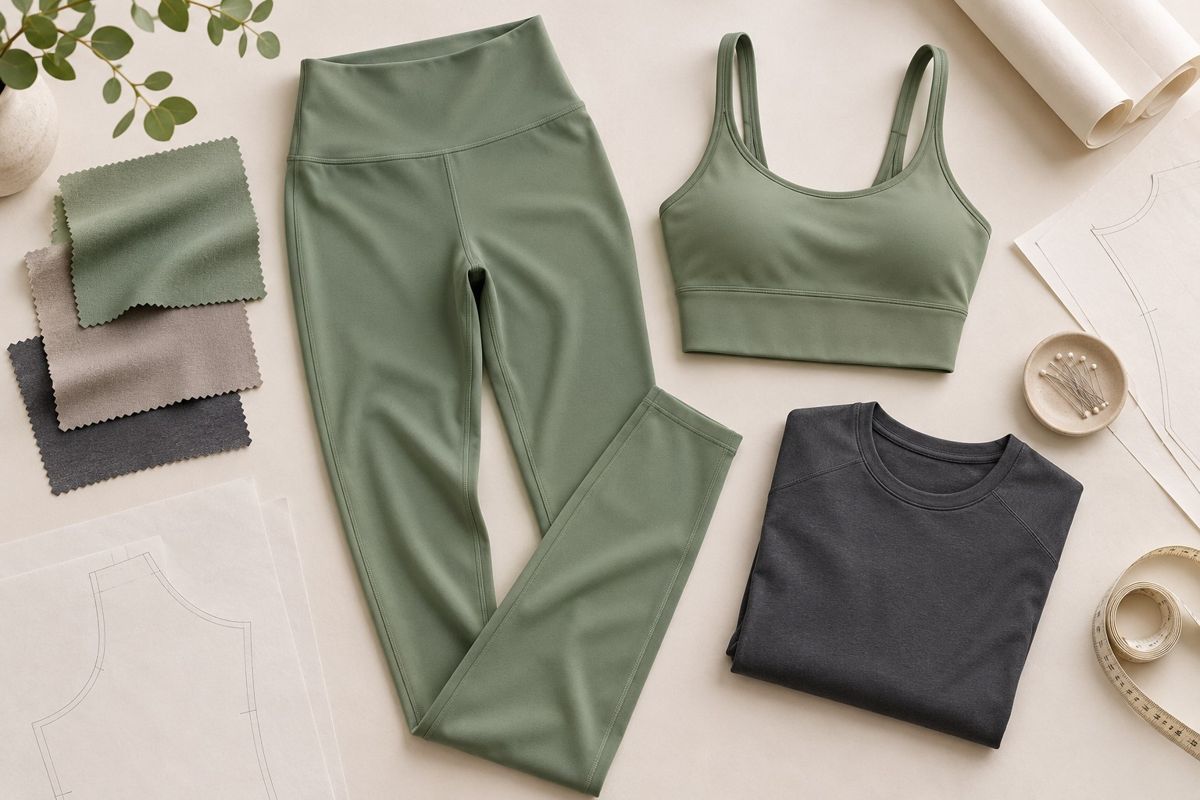
Build a yoga collection around movement, measurable fit and a sample-to-bulk approval plan.
For clothing brands, product developers and sourcing teams · Published 6 November 2026
Custom yoga wear manufacturing turns a brand’s movement, fit and design brief into approved garments for production. Specify the intended practice, fabric behaviour, coverage, sizing and branding; then validate samples in movement and after washing. Approve each garment and the coordinated set together, and confirm minimums, costs, inspection criteria and delivery milestones before ordering.
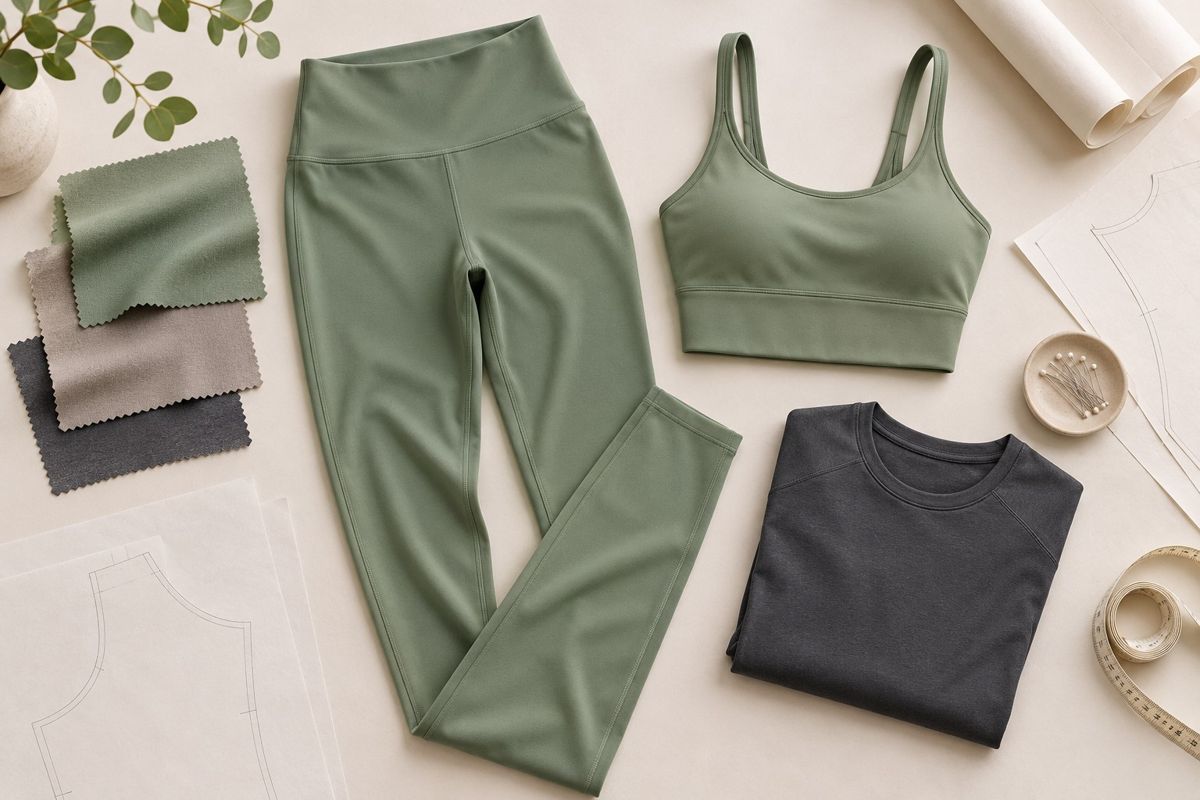
What is custom yoga wear manufacturing?
Custom yoga wear manufacturing is the development and production of garments to an agreed yoga-focused specification. It may include leggings, shorts, bras, fitted tops and layering pieces. The brief connects the intended practice and wearer with fabric, pattern, seams, coverage, labels and packaging.
A yoga collection needs more than a coordinated appearance. A waistband that sits well while standing may roll during a forward fold; a top that looks balanced on a hanger may expose more than intended when the wearer reaches overhead. These are design questions to resolve in samples.
Stretch is the material’s ability to extend under defined conditions. Recovery is its ability to return after extension. Opacity describes resistance to show-through under the assessed conditions. GSM means grams per square metre, a measure of fabric mass per area. None of these terms, by itself, establishes finished-garment performance.
Keep intended uses distinct. Gentle studio practice, vigorous flow and heated sessions may lead to different priorities. A yoga bra does not automatically meet a running support brief, and a casual matching set should not inherit performance claims from a similar-looking technical garment.
Browse Ohsure’s custom yoga set collection for silhouette references, then discuss the specification through its custom yoga wear manufacturing service.
Compare fabric options against the intended practice
Use fibre names to organise sourcing, then compare actual fabric references. The same nominal composition can produce different handfeel, coverage and recovery when the knit, weight or finish changes. The table below is a buyer decision aid, not a specification or a promise about every fabric in a category.
| Option | Possible development role | What to verify |
|---|---|---|
| Nylon/spandex stretch knit | Close-fitting leggings, bras and coordinated studio pieces | Surface feel, recovery, opacity under extension, pilling and colour transfer |
| Polyester/spandex stretch knit | Fitted yoga apparel where the chosen fabric meets the movement and care brief | Handfeel, sweat appearance, drying performance if claimed, recovery and print compatibility |
| Cotton/spandex or modal/spandex | Soft tops and selected relaxed or fitted pieces | Dimensional change, wet feel, recovery and whether the fabric suits the proposed lower-body fit |
| Recycled-content stretch fabric | An alternative sourcing route for a suitable garment fabric | Exact composition, availability, traceable claim documents and the same functional checks as other fabrics |
Write a material brief the sample room can use
Record the supplier’s fabric code, composition, knit description, target weight and agreed tolerance, usable width, colour reference, surface finish and stretch directions. Ask how extension and recovery will be assessed. “Four-way stretch” without a method or an agreed sample does not define how much extension is available or what happens after repeated movement.
There is no universal GSM that guarantees squat coverage. A heavier sample may still show through when overstretched, while a lighter fabric may meet a different fit and coverage brief. Compare the actual colour and garment size under the agreed conditions. If a lighter shade requires lining or a design revision, include that choice in costing before approval.
For heated practice, assess the wearer’s experience of wet fabric, rubbing and surface appearance as well as the dry handfeel. Claims such as moisture-wicking or quick-drying need relevant evidence for the selected material or garment; they should not be inferred from the fibre name.
Ohsure’s activewear fabric guide provides a starting point for discussing material options. Confirm the exact reference and availability for the order.
Validate fit in yoga movements, not only standing photos
Keep the target body-measurement chart separate from the finished-garment chart. Label flat widths, circumferences and lengths clearly, and specify how each point is measured. Record waist, hip, rise, inseam, leg opening and waistband dimensions for leggings; add relevant coverage, band and strap points for bras and tops.
Do not use a smaller pattern as a substitute for a defined compression brief. Discuss negative ease—the amount by which a garment dimension is smaller than the corresponding body dimension—alongside the selected fabric’s extension and recovery. Resolve pressure, coverage and movement through fitting.
| Review | Observe | Record for comparison |
|---|---|---|
| Forward fold or deep hip flexion | Rear coverage, waistband roll, crotch pulling and show-through | Sample revision, size, wearer body measurements, fabric colour, lighting and underlayer |
| Lunge and wide stance | Range of movement, inner-thigh pressure, seam strain and waistband migration | Agreed movement sequence, observations and locations of any restriction |
| Overhead reach and torso rotation | Top and bra coverage, strap movement, armhole rubbing and hem lift | Starting fit, movement observations and wearer feedback |
| Floor contact and repeated wear | Bulky seam junctions, label discomfort, surface abrasion and recovery | Agreed duration, contact conditions, photos where consented and corrective action |
| Care review | Dimensional change, twisting, colour transfer, logo condition and cup position where used | Care procedure, agreed cycle count, before/after measurements and acceptance limits |
Use representative sizes and body shapes, including the intended range’s edges. A single approved middle size does not establish that the grading works throughout the range. If the bra and bottom are sold in the same labelled size, check whether the intended customers need separate size choices.
An in-house movement screen is useful for development, but it is not a universal performance certification. Define what counts as acceptable coverage, movement and comfort before reviewing samples. For marketing claims that need laboratory evidence, agree suitable methods and a qualified testing provider separately.
Approve the coordinated set as one visual product
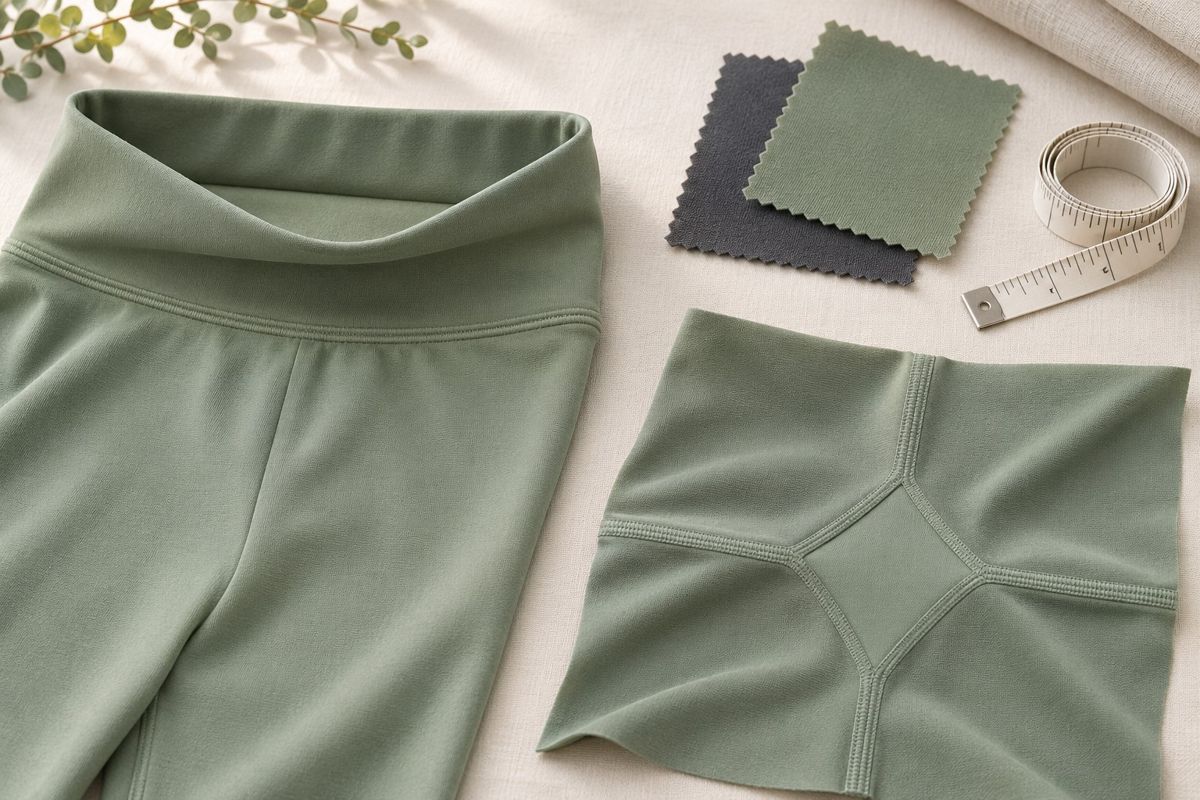
A matching set can use different fabric weights or constructions in the bra and leggings. Even when both carry the same colour name, the surface and shade can appear different. Approve the actual materials together under agreed lighting, then review the complete garments together.
Keep a physical colour standard and labelled approved swatches. For a custom-dyed colour, request a lab dip—a small dyed submission for colour approval—before bulk dyeing, and agree how the bulk shade will be checked. Reassess the pairing if one component’s fabric or finish changes.
Specify logo size, orientation and position relative to a repeatable seam or measurement point. Check the decoration at the extension expected in wear and after the agreed care review. A large, stiff logo at a fold or stretch zone can change comfort and appearance; approve it on the intended fabric, not only on a digital mock-up.
If adding a custom leggings style or a custom sports bra to an existing collection, compare its actual sample with the retained collection standard.
Seven steps from concept to bulk approval
The sequence below is a buyer planning workflow. Agree the project’s actual responsibilities, documents and approval points with the manufacturer.
Define the collection and wearer
State the intended practice, customer, size range, silhouettes, target selling proposition and destination. Identify which claims need evidence and which features are simply design preferences.
Build the technical specification
Provide drawings, measurement diagrams, target body chart, construction details, bill of materials, colours, logos and packaging requirements. Resolve ambiguities in a reference photo before the pattern is developed.
Shortlist and approve materials
Compare identified swatches against the same brief. Check material minimums, stock or custom colour status, sample availability and compatibility between set components. Keep labelled approval references.
Develop and review the first sample
Measure the sample and perform the agreed movement review. Record each issue with its location, observation and requested outcome. Use one revision log rather than scattered messages with competing instructions.
Check revisions, size range and care behaviour
Reassess revised areas without losing previously approved features. Review representative sizes, the coordinated set, branding and care results. Tie every approval to the sample and specification revision.
Freeze the order and production reference
Approve the final sample, material references, size breakdown, price basis, inspection requirements and packing instructions in writing. Agree whether any pre-production submission is needed and what changes require renewed approval.
Inspect, pack and release for shipment
Check the agreed inspection records against the order. Resolve discrepancies, confirm garment and carton counts, and verify size/colour identification. Arrange transport with the agreed responsibility for release and delivery documents.
Use the yoga wear approval checklist below to track sample revision, criterion, result, owner and corrective action.
Plan quantities, development cost and time together
Ohsure’s published starting MOQ is 100 pieces per style per colour, with mixed sizes available. Final order requirements are subject to project confirmation. Ask explicitly how complete sets, separate components and design variants are counted.
Worked MOQ example: one bra and one legging in two colours
Assumption: each component counts as a separate style, each colour requires 100 pieces per style, and no additional material minimum applies.
2 garment styles × 2 colours × 100 pieces = 400 garments.
If each colour has 100 bras and 100 leggings, this gives 200 two-piece sets. It is not 400 sets. An illustrative size split per style/colour is S 20 + M 35 + L 30 + XL 15 = 100 pieces; choose the actual split from your own demand and fitting evidence.
This is a planning calculation, not an Ohsure quotation. Confirm the supplier’s set-counting convention and all minimums before placing the order.
| Factor | Cost or time effect | Question for the quotation |
|---|---|---|
| Fabric and colour | Custom dyeing, lining, finishing or material minimums may add cost and approval time | Is the material available, and what needs approval before sourcing or dyeing? |
| Pattern and sampling | New construction and revisions add development work | What is included in sampling, and how are further revisions charged and scheduled? |
| Branding and packaging | Technique, placement, artwork and component minimums affect the quote | Are setup, labels, hangtags and individual packaging included? |
| Testing and inspection | Scope and external testing can add fees and elapsed time | Which checks are included, which are separately quoted, and who approves results? |
| Production and delivery | Capacity, material readiness, inspection and transport affect the arrival date | What starts the production clock, and is freight or import cost included? |
Planning formula: total order budget = quoted garment cost + development/setup + separately quoted testing/inspection + packaging not included in the garment quote + freight + applicable import costs. Count each item once. Compare quotations on the same specification, quantity and delivery basis.
Timing: sample timing is confirmed after reviewing the design, materials and customisation requirements. Bulk-production timing is confirmed according to the approved specifications, material availability and production schedule. Build the launch plan around dependencies: material approval, sample revisions, final approval, production, inspection and transport. Some tasks may overlap only by agreement.
Ask for milestone dates and the action that starts each stage. A production estimate does not include every day between first inquiry and warehouse arrival. Reserve a revision allowance based on the project’s complexity instead of assuming first-sample approval.
Common mistakes that make yoga wear harder to approve
- Buying by softness alone. Add movement, coverage, recovery and care checks before approving the fabric.
- Calling a fabric “squat-proof” from a hand stretch. Evaluate the finished garment in the actual size, colour and agreed conditions; limit the claim to supported evidence.
- Approving only a standing fit photo. Include hip flexion, reaching, floor contact and wearer feedback.
- Copying one size without reviewing grading. Check representative sizes and the intended body ranges before bulk approval.
- Matching sets from screen colours. Approve the actual fabrics and garments together against a retained reference.
- Adding decoration after functional approval. Review the logo on the final fabric and at the intended placement, including stretch and care.
- Mixing garment pieces with set quantities. Show both component totals and complete-set totals on the order.
- Changing the fabric after approving fit. Recheck affected measurements, movement, colour and care behaviour before release.
What Ohsure’s manufacturing services mean for this project
The supplied Ohsure article fact library identifies a Dongguan-based activewear manufacturer supporting OEM, ODM and private-label work. Its OEM/ODM service page describes development and customisation services. Use that discussion to establish whether your project starts from a detailed buyer specification, a concept needing development, or an existing style requiring agreed changes.
The practical handover is one controlled package: drawings, material references, measurements, branding artwork, quantity matrix and approval criteria. Ask the sample team to list open questions before development. After fitting, return a dated revision sheet with photographs where useful and a clear approval status for every issue.
Ohsure’s quality-control page describes raw-material checks, printing-process inspection, semi-finished sampling and finished-garment inspection. Its published items include colour difference, fabric weight, pilling, colourfastness, shrinkage, measurements, stitching and accessories. For your order, agree the methods, tolerances, sampling and reporting requirements separately.
This manufacturer perspective is based on the supplied fact library and public service descriptions. It does not present an invented customer case, a factory visit or an independently verified yoga-product test result.
Yoga wear approval checklist
For each item, record the sample revision, style, colour, size, method and conditions, agreed criterion, result, owner, corrective action and approval date.
| Stage | Check |
|---|---|
| Brief | Intended practice and target wearer |
| Specification | Measurement diagrams and size grading |
| Materials | Fabric code, composition, weight and tolerance |
| Movement | Opacity and rear coverage in hip flexion |
| Movement | Waistband stability and freedom in lunge |
| Movement | Top coverage during reach and rotation |
| Construction | Gusset, seams and labels comfortable in floor contact |
| Set approval | Actual component fabrics and colours approved together |
| Branding | Placement, stretch and care checks |
| Care | Before/after dimensions, surface, colour and logo |
| Quantities | Pieces per style/colour and complete-set count |
| Production | Final sample and revision-controlled specification |
| QC | Methods, tolerances, sampling and reports agreed |
| Delivery | Milestones, release responsibility and transport basis |
Frequently asked questions
What should a clothing brand send to a yoga wear manufacturer?
Send the intended practice, target body-size chart, garment drawings or references, measurement points, fabric requirements, colours, branding artwork and quantity by style, colour and size. Include movement and care acceptance criteria, target delivery date and destination. Ask the supplier to identify missing details before sampling.
Is nylon/spandex always better than polyester/spandex for yoga wear?
No. Fibre composition is one input. Knit construction, weight, finish, stretch, recovery, colour and garment fit also matter. Compare identified swatches and completed samples against the same brief rather than choosing from a fibre name or softness description alone.
What fabric weight makes yoga leggings opaque?
There is no single weight that guarantees opacity in every garment. Colour, knit structure, extension and fit affect coverage. Agree a repeatable check using the intended sizes, lighting, underlayer and movements, and evaluate the finished garment before making a coverage claim.
Can the bra and leggings in a set use different fabrics?
Yes, if the combination meets the brief. Approve the actual fabrics side by side and as a worn set, because shade, surface appearance and care behaviour can differ. Keep separate material references and acceptance records for each component.
Does a 100-piece MOQ mean 100 complete yoga sets?
Not automatically. Ohsure’s published starting MOQ is 100 pieces per style per colour, with mixed sizes available, subject to project confirmation. Ask whether the bra and leggings count as separate styles and whether a set-specific quotation uses pieces or complete sets.
How long does custom yoga wear development take?
Sample timing is confirmed after reviewing design, materials and customisation requirements. Bulk-production timing depends on approved specifications, material availability and the production schedule. Allow separately for revisions, material approval, testing, inspection and transport; agree when each timing commitment starts.
Can a yoga bra also be advertised for running?
Only when its fit and support have been evaluated for the intended running use and wearer range. A yoga silhouette, snug feel or padded cup alone does not substantiate high-impact support. Define the separate claim and evidence before extending the product positioning.
Can I order recycled yoga wear with a sustainability claim?
Discuss recycled material availability, composition and order minimums with the manufacturer. Obtain documentation that supports the exact material and wording used for the order. Recycled content does not by itself prove durability, performance or a broader environmental benefit.
Prepare a yoga wear brief for quotation
Choose the first silhouettes, define the intended practice and wearer, and prepare a quantity matrix by component, colour and size. Include the checks that matter to the customer: coverage in movement, comfortable seam placement, waist stability and care behaviour. Use the Ohsure yoga wear manufacturing service to discuss material choices and the sample plan, then approve the specification before committing to bulk.
Sources and editorial basis
Primary supplied reference: Ohsure文章事实资料库. Article assignment: row 84 of the supplied 100-article content plan. Public service and catalogue references were reviewed on 6 November 2026:
- Ohsure custom yoga wear manufacturing service — service scope and starting MOQ.
- Ohsure fabric guide — material discussion context.
- Ohsure OEM/ODM services — development and customisation context.
- Ohsure quality control — published inspection activities.
Fabric comparisons, movement reviews, workflow and calculations are editorial buyer guidance, not published Ohsure acceptance standards or quoted prices. AI images illustrate generic concepts.