How to Design Nursing Sports Bras With Functional Access
- Share
- Issue Time
- Oct 27,2026
Summary
Design nursing sports bras with practical feeding access. Compare clips, crossover panels, inner slings, sample checks, cost factors and OEM development steps.
B729-66 · NURSING ACTIVEWEAR DESIGN GUIDE
Direct answer
Design nursing sports bras by integrating feeding access with the cup, strap and underband structure from the first pattern. Compare drop-down clips, crossover panels and layered openings, then test one-handed use, feeding clearance, secure reclosing and comfort across the intended size range. Validate movement and wash performance separately before making support or durability claims.
A nursing clip can open perfectly on a desk yet become difficult to find or reconnect when the bra is worn. An overlap can look generous on a small sample yet provide inadequate clearance in a fuller cup. Functional access is therefore a whole-garment design problem: the wearer must reach the opening, move the fabric away, keep the remaining structure manageable and restore a secure fit.
1. What does functional nursing access mean?
A nursing sports bra combines a garment intended for activity with an opening that allows breastfeeding without removing the entire bra. “Functional access” means that the opening works in the worn garment: it can be reached, opened, cleared and closed without losing control of the straps or leaving folded fabric in the feeding area. The access route should be assessed on each side independently.
A maternity sports bra accommodates pregnancy-related fit needs; a nursing version adds feeding access. A pumping bra adds a different requirement: holding specified pump components in position. Feeding access does not establish hands-free pumping compatibility. Likewise, “sports bra” does not establish high-impact support. Define the intended activity and the evidence needed for each product claim in the brief.
Comfort must remain a design constraint. La Leche League International’s bra guidance advises avoiding bras that are too tight. Translate this into fit assessment and wearer feedback, rather than promising medical benefits or a universal pressure limit. A garment specification cannot determine an individual’s readiness to return to exercise.
2. Compare access structures before approving the silhouette
| Access structure | Useful design direction | Main tradeoff | What to observe |
|---|---|---|---|
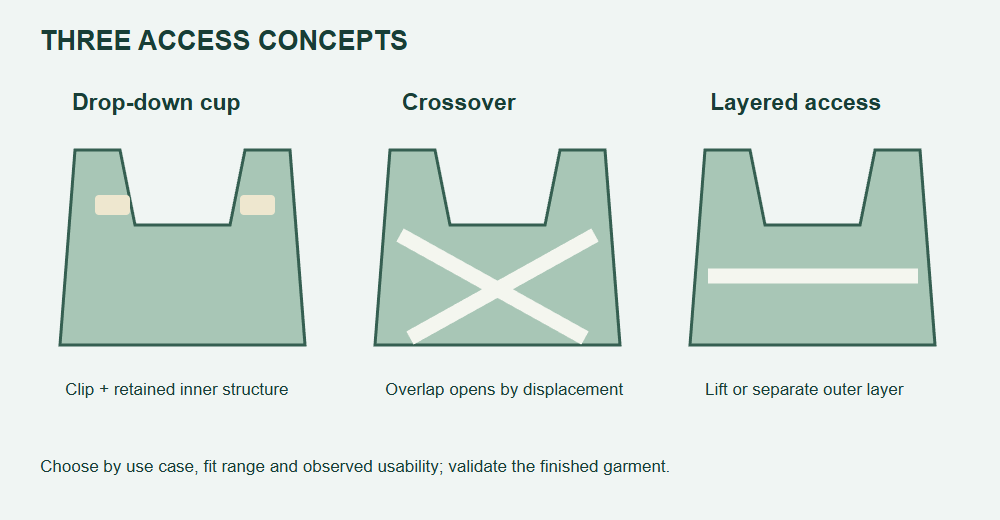
| Drop-down cup with clip | Separate opening for each breast; an inner sling can retain the strap | Hardware, attachment seams and folding layers add complexity | Can the wearer release and reconnect each side without retrieving a lost strap? |
| Crossover or pull-aside | Hardware-free access through overlapping stretch panels | Opening size depends on overlap, extension and breast volume | Does it clear sufficiently without excessive pulling, edge pressure or neckline distortion? |
| Layered lift-up / pull-down | Outer coverage can conceal a separate feeding opening | Layer bulk and handling can complicate access | Can all layers be moved clear and returned without bunching or twisted lining? |
These are development options, not a ranking of support. A crossover design may need more containment for its intended activity; a clip design may still have an unstable band. Compare prototypes at the same target fit and use conditions before choosing. Avoid approving one access concept simply because a component supplier calls it a sports-bra clip.
3. Engineer the cup, inner sling and closure together
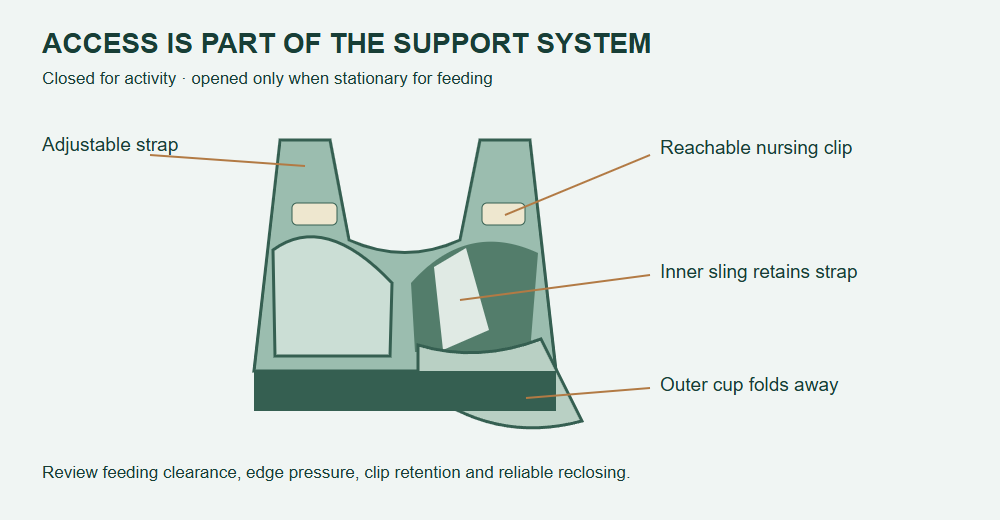
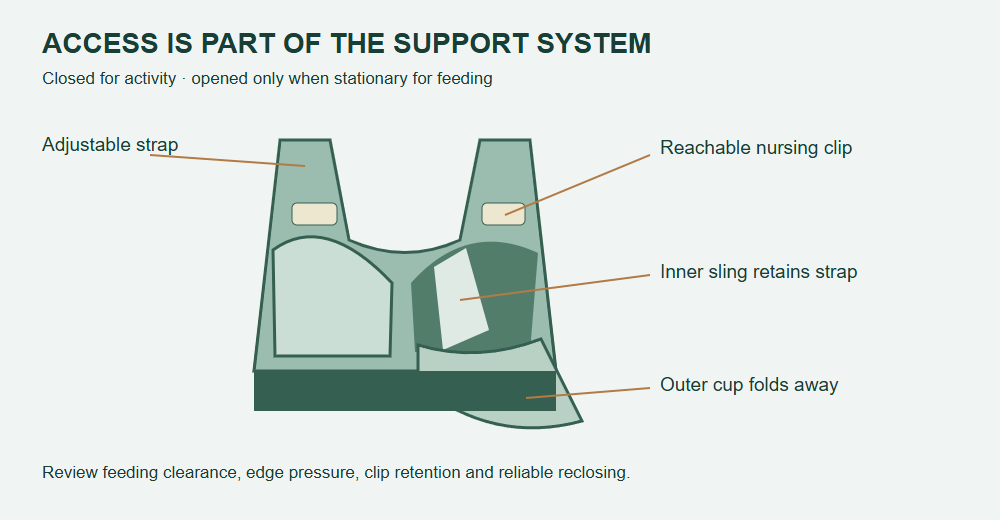
Retain the strap when the outer cup opens. In a drop-down construction, the inner structure can keep the shoulder strap connected to the body of the bra. Its shape must provide useful access without becoming a narrow pressure edge. A side sling and a more enclosing inner frame expose different areas; neither is universally suitable. Have the pattern maker compare the proposed opening on representative cup volumes.
Specify the clip interface. Record the component reference, attachment width, orientation, strap or tape width, stitch construction and reinforcement. A clip that works with one elastic may rotate, slip or sit awkwardly with another. Position it where the wearer can reach it, while checking its skin-facing surface and the folded cup position. A secure closure should also give a recognizable indication that it has engaged.
Keep the cup clear. Trace where the shell, lining and pad go when the opening is used. A removable pad pocket must remain contained; loose pads or folded lining should not obstruct access. If pads are included, evaluate whether they twist, migrate or become difficult to reinsert after care. Removable foam pads should not be described as absorbent nursing pads without supporting product evidence.
Preserve the closed fit. After reclosing, the cup should return to its intended position without trapped layers or a twisted strap. Review band stability, cup capacity, side coverage and strap adjustment independently. Increasing compression to compensate for a poor opening pattern can create a new comfort problem.
4. Select materials by zone and care behavior
| Component | Specify in the development brief | Check in the assembled sample |
|---|---|---|
| Shell and cup lining | Composition, construction, weight, color, extension and supplier reference | Coverage, recovery, edge feel and compatibility after care |
| Underband and strap elastic | Width, extension behavior, intended adjustment and attachment | Rolling, shifting, pressure feedback and slider retention |
| Nursing clips and sliders | Supplier reference, dimensions, orientation and finish | Reliable engagement, edges, rotation and retention after repeated use |
| Pads, pockets and labels | Fixed or removable construction; location and care instructions | Pad migration, seam bulk, drying behavior and skin contact |
Softness alone does not establish suitable recovery or support. Sample the shell and lining together: differential shrinkage or stretch can distort the opening. Include the lightest intended color when reviewing coverage and the most demanding print or branding placement when checking seam bulk. If fabric or hardware is substituted, identify which fit, access and care checks must be repeated.
Choose a care method compatible with the complete bill of materials. Agree whether pads are removed for washing and how the garment is dried. Evaluate the resulting bra after the agreed wash sequence; do not infer finished-garment durability from a fabric swatch. Claims such as quick-drying, antibacterial or certified recycled require evidence appropriate to the exact claim.
5. Follow a six-step sampling and approval process
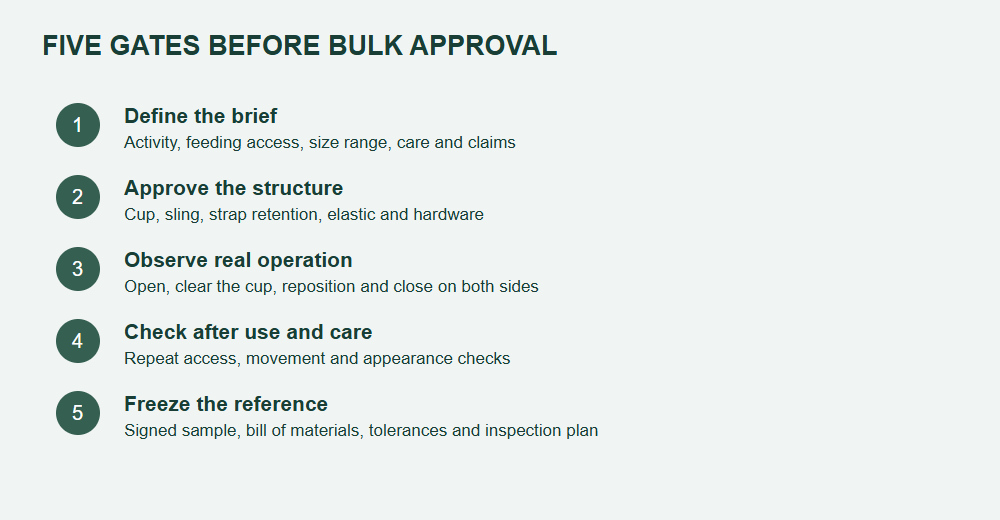
- Write a measurable brief.
State the target market, activity, size architecture, feeding opening, adjustment range, pad preference, care method and proposed claims. Record body measurements separately from finished garment measurements. Include the expected use with outer clothing so that access is not assessed only on an uncovered bra.
- Compare construction prototypes.
Ask the pattern maker to review opening geometry, inner support, cup depth, clip location and reinforcement. If the concept is undecided, compare two access options before committing to the complete size set. A flat reference photograph is insufficient to define the hidden layers.
- Run a controlled usability session.
Use consenting adult wearers representative of the intended range. Let each person locate, open, clear and reconnect both sides while stationary. A doll can help simulate handling; do not carry a baby during movement testing. Observe the task before coaching, then record any instructions needed.
- Review fit across the size architecture.
Include representative smaller and larger sizes, fuller-bust proportions where relevant and borderline measurements. Check the opening itself, not just the outside silhouette. Record spillage, gaping, band movement, strap retrieval and pressure feedback. Do not promise one fit throughout lactation from one successful trial.
- Repeat after movement and care.
Assess the closed garment in the intended activity, then recheck access while stationary. Repeat opening and reclosing after the agreed care and component-use sequence. Investigate unintended release, rough edges, slippage, seam damage or failure to clear the cup before approval.
- Freeze the production reference.
Sign off the revised sample, measurement chart, tolerances, bill of materials, clip orientation, stitch details and labeling. Agree inspection sampling and the handling of critical functional failures. Retain a reference sample and require approval before component substitution.
6. Use an evidence sheet instead of an unsupported performance claim
The following is a proposed recording template, not Ohsure test data or a universal standard. Agree task instructions, sample sizes, conditioning, wash method, cycle counts and acceptance criteria with the product specialist and supplier before testing. Evaluate repeated operation and closure retention separately; an opening can be easy to use and still release unintentionally.
| Check | Record | Decision before approval |
|---|---|---|
| One-handed access | Side used, completion, retries, task time and assistance | Define allowable retries and assistance for the intended user task |
| Feeding clearance | Cup position, sling edge, folded layers and wearer feedback | Opening clears the intended area without persistent obstruction |
| Reclosing | Engagement feedback, alignment, trapped lining and strap position | Wearer can restore the intended closed configuration |
| Closed movement | Activity sequence, band shift, coverage and unintended opening | Resolve functional failures; substantiate the intended support claim separately |
| After care and repeated use | Agreed conditions, cycles, appearance, seams, pads and hardware function | Meet the agreed specification before approving the sample |
For a timed usability task, define the start and finish consistently—for example, from reaching for the clip to the cup being clear, and separately from starting to reclose to verified engagement. Report the spread of observations and failures as well as the average. A fast result from one trained tester does not establish accessibility across the size range.
Assess finished garments using methods appropriate to the intended market and claims. Have relevant technical and compliance specialists review the product specification, care labels and consumer wording. Do not publish “prevents mastitis,” “increases milk supply,” or similar health outcomes on the basis of garment fit trials.
7. Budget for construction, revisions and approval time
| Cost or time factor | Why it changes the project | How to control uncertainty |
|---|---|---|
| Opening architecture | Clips, slings, layers and reinforcement add components and sewing steps | Cost an agreed construction and bill of materials |
| Size range | Different band/cup proportions may require extra patterns and trials | Decide size architecture before grading |
| Materials and colors | Availability and material minimums can affect quantities and schedule | Confirm stock, dye requirements and approved substitutes |
| Sampling and verification | Revisions, wearer sessions and care checks require time | Allow a separate review loop before bulk authorization |
| Branding, packing and delivery | Labels, artwork, packing and transport affect landed cost | Request itemized terms and confirm the shipping arrangement |
Compare quotations at the same scope. A useful worksheet separates development and sample charges, any tooling, bulk garment cost, branding, packaging, agreed testing and transport. Calculate landed cost per sellable unit using the confirmed delivery terms; include applicable import charges for the destination rather than assuming they are included in the factory price.
Ohsure’s published starting MOQ is 100 pieces per style per color, with mixed sizes available; final requirements are subject to project confirmation. Illustratively, one style in two colors means a starting discussion around 200 pieces if that MOQ applies to both colors. It does not mean 100 pieces spread across any number of styles and colors. This is a quantity example, not a quotation.
Sample timing is confirmed after reviewing the design, materials and customization requirements. Bulk-production timing is confirmed according to the approved specifications, material availability and production schedule. Request milestone dates for materials, first sample, feedback, revised sample, approval, bulk completion and dispatch. Do not treat shipping transit or buyer review time as part of an unqualified factory production promise.
8. Common design mistakes and practical corrections
| Mistake | Why it fails | Correction |
|---|---|---|
| Adding clips after the pattern is approved | The cup may drop with the strap or create an awkward opening | Develop the inner attachment and opening geometry together |
| Making the band tighter to increase support | Extra tension can mask poor cup fit and create discomfort | Review band, cup volume and strap position separately |
| Testing only the smallest sample | Access proportions and folded bulk change with size | Check representative sizes and fuller-bust variants |
| Approving a clip by touch alone | Bench operation misses worn position and layer tension | Assess each side on the completed worn garment |
| Ignoring post-wash access | Distorted lining or migrated pads can obstruct the opening | Repeat functional checks after the agreed care sequence |
| Calling nursing access pump-compatible | Feeding clearance does not prove pump retention | Develop and verify any pumping function as a separate use case |
9. A manufacturer’s development perspective: make the hidden details reviewable
For a nursing bra, the most useful factory discussion is often about the parts missing from the reference photograph: the inner sling, strap attachment, clip orientation, lining seam and pad pocket. Ask for inside and outside sample photographs and a short opening/reclosing demonstration. Convert comments such as “the cup is awkward” into a located issue, an observed task and a proposed pattern or component change. This is practical development guidance, not a claim about a completed customer project.
Ohsure is based in Dongguan, Guangdong, China, and offers OEM, ODM and private-label activewear development, including maternity and nursing garments. Its published services include reference-based sampling, material selection, branding and packaging. Review the maternity and nursing activewear product range and custom sports bra collection when preparing the initial brief. Confirm the specific nursing construction and component availability for your project.
The custom maternity activewear service provides a related starting point for coordinated development; private-label services cover branding discussions. Ohsure’s quality-control page describes raw-material, printing-process, semi-finished and finished-garment inspection stages. Add nursing access checks to the agreed inspection plan rather than assuming general garment inspection establishes closure usability or support performance.
Prepare your inquiry: send front, back and inside references; target body measurements; intended activity; preferred access route; pad and lining requirements; branding artwork; quantity by style, color and size; and target delivery date. Ask which items need development, which can use existing components and which claims require additional evidence.
10. Frequently asked questions
What is the difference between a maternity bra and a nursing sports bra?
A maternity bra focuses on pregnancy-related fit and comfort. A nursing sports bra also requires a feeding opening and an intended activity specification. A maternity garment becomes a nursing design only when the access function is engineered and checked.
Are clips better than crossover nursing access?
Neither is universally better. Clips provide a defined opening but add hardware and attachment requirements. Crossover access avoids clips but depends on overlap and stretch. Compare clearance, comfort, recovery and reclosing on the intended wearers.
How do you check one-handed operation?
Observe each side separately on the worn garment. Record reaching, releasing, clearing fabric and reconnecting, including retries or assistance. Repeat under the agreed conditions after care. Define the task and acceptance criteria before collecting results.
Can the same bra support exercise and feeding?
That is a possible design goal, but the closed garment’s activity performance and the stationary feeding-access task require separate assessment. Open the cup for feeding while stationary, then restore and verify the closure before activity.
Does a nursing sports bra work with a breast pump?
Not automatically. Feeding openings do not establish hands-free retention or compatibility with a particular flange, wearable pump or collection unit. Specify and evaluate pump compatibility separately before advertising it.
What MOQ and lead time should a brand expect from Ohsure?
The published starting MOQ is 100 pieces per style per color, with mixed sizes available, subject to project confirmation. Sampling and bulk timing depend on the reviewed design, materials, approved specifications and production schedule. Request a project-specific quotation and milestone plan.
Sources and evidence boundaries
Company details are based on the supplied Ohsure article fact library and the linked Ohsure product and service pages. Comfort context: La Leche League International — Bras. The construction comparisons, diagrams and proposed checklists are editorial development guidance; they are not laboratory findings, a production pattern, a certification or evidence of a completed Ohsure trial. No specialist approval or completed test result is claimed.