How to Design a Maternity Sports Bra: Support, Comfort and Adjustability
- Share
- Issue Time
- Oct 26,2026
Summary
A practical maternity sports bra design guide covering support construction, cup capacity, underband and strap adjustment, materials, sample validation, cost factors and common mistakes.
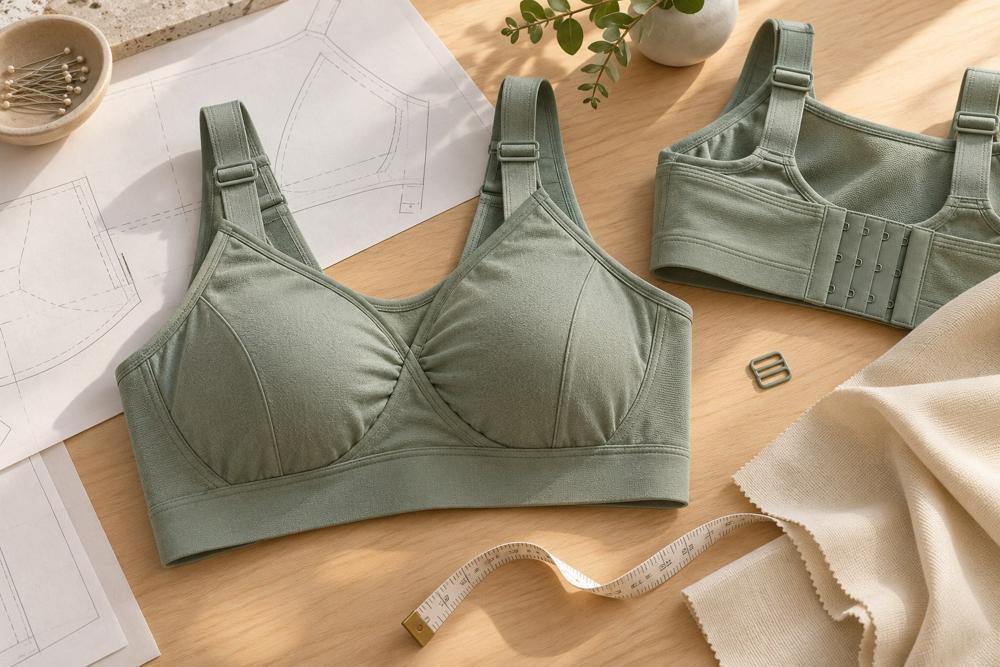
Design a maternity sports bra around a stable underband, sufficient cup capacity, comfortable skin-contact materials and independently adjustable straps and closure. Define the intended activity and body-measurement range first, then validate fit, movement, hardware retention and wash performance across that range. Stretch alone does not establish support, comfort or a fit that lasts throughout pregnancy.
For brands developing maternity activewear, the central challenge is accommodating change without losing control of fit. A larger version of a regular crop top may still have the wrong cup depth, band tension or strap geometry. This guide turns those decisions into a sampling brief, a comparison framework and a practical approval process.
1. What is a maternity sports bra?
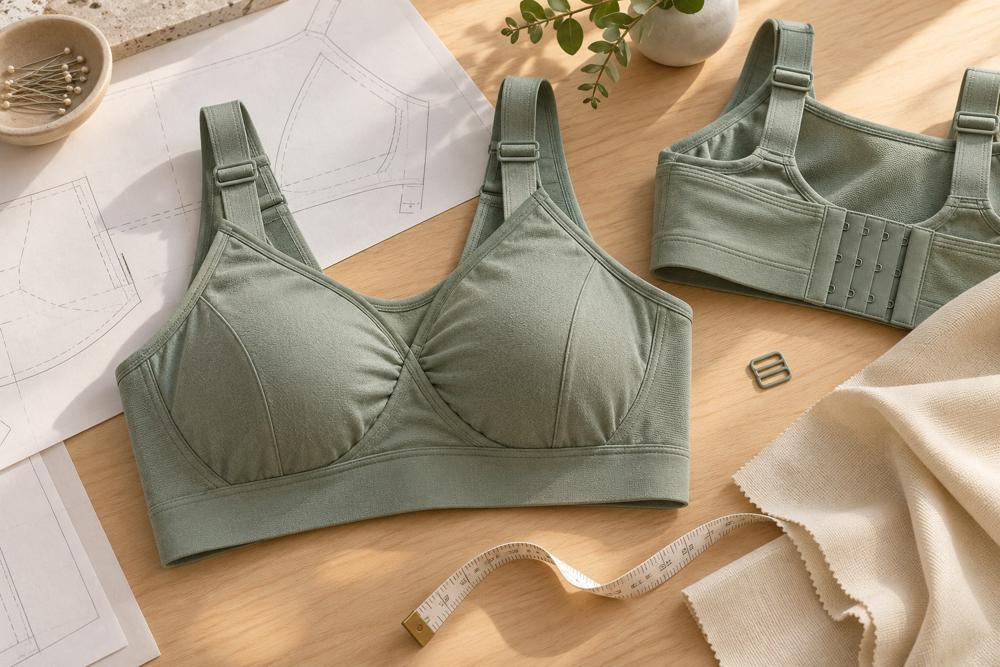
A maternity sports bra is an activity-oriented bra developed around the fit and comfort needs of pregnancy. Its specification should identify the intended breast and underbust measurement ranges, support objective and available adjustment. The word “maternity” describes the design purpose; it does not prove a particular level of support or guarantee that one size will fit every stage.
A nursing sports bra adds a separate requirement: access for feeding. Drop-down clips, overlap panels and feeding slings introduce different construction and usability checks. Decide at the brief stage whether the product is maternity-only or dual-purpose, rather than adding clips after the support pattern has been approved.
Pregnancy can bring changes in breast size and sensitivity. NHS guidance on breast care during pregnancy emphasizes a supportive, comfortable fit without restriction. For a product team, that means defining a usable fit range and a clear refitting message instead of promising a fixed number of cup sizes or universal trimester coverage.
2. Compare support structures before choosing the silhouette
Compression brings the breasts closer to the chest; encapsulation uses separate cups; combination construction uses both approaches. These definitions follow University of Portsmouth breast-health guidance. Treat them as construction categories. Any support claim still needs evidence from the finished garment in its intended sizes and use conditions.
| Construction | Development opportunity | Tradeoff to check | Approval question |
|---|---|---|---|
| Compression-led crop | Simple silhouette with fewer cup seams | A stretchy front may lack containment for some breast volumes | Does coverage stay stable without excessive pressure? |
| Encapsulation-led bra | Separate cup shaping and more targeted volume | More pattern pieces or molded components may complicate grading | Do both cups contain the wearer across the intended range? |
| Combination design | Cup shaping plus an outer supporting layer | Additional layers can add heat, bulk and sewing operations | Does the added structure improve the intended use without discomfort? |
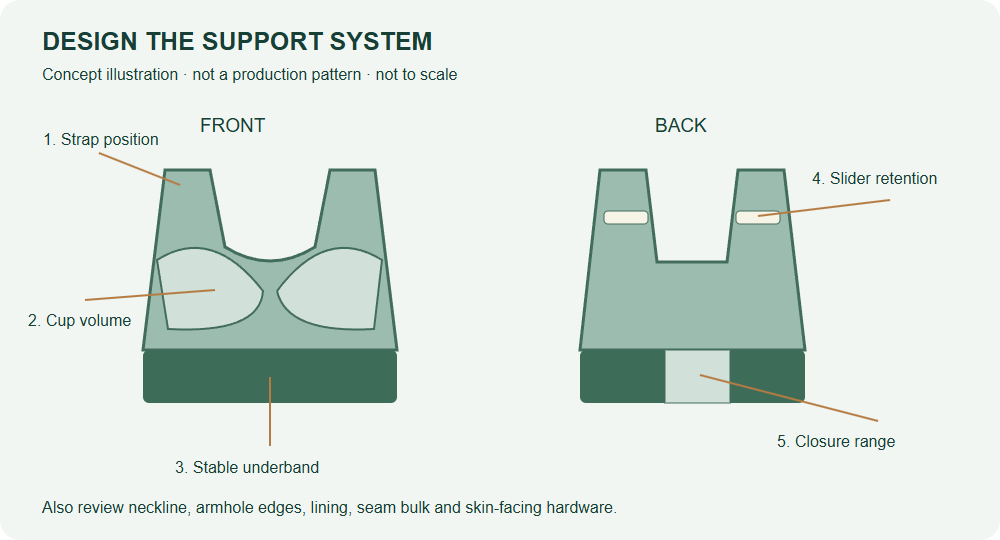
Develop the underband, cups and straps as one system. A stable band provides an anchor; cup depth and side coverage help contain the breast; strap placement helps maintain position. Tightening the straps to compensate for an unstable band is a poor pattern correction. A higher neckline or broader strap can be worth prototyping, but neither feature establishes support on its own.
3. Make band, cup and strap adjustment work independently
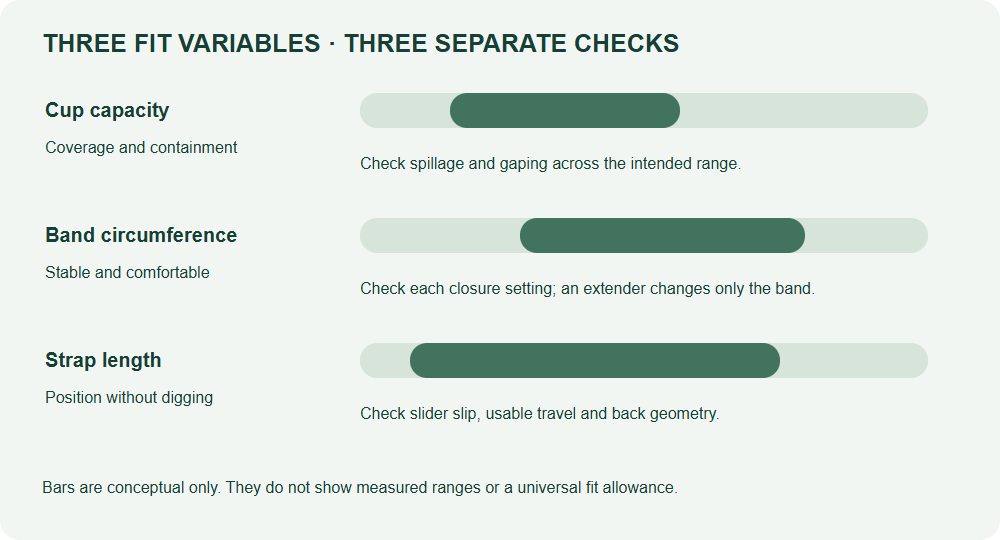
Start with a size chart that states the measurement method and target market. Use underbust and bust measurements as inputs, then assess the actual garment on wearers. A single S–XL scale may cover a broad mix of band and cup proportions; consider separate band/cup sizes or fuller-bust variants where fit trials show a gap.
Specify finished measurements in a defined relaxed state, with the closure setting, measurement landmarks and tolerances recorded. Add the intended body-measurement range separately. Finished garment dimensions and body dimensions serve different purposes and should not be substituted for one another.
| Feature | What it can change | What it cannot fix | Sampling check |
|---|---|---|---|
| Multiple hook-and-eye settings | Underband circumference in discrete steps | Insufficient cup depth or unsuitable strap position | Assess fit at every setting; check skin-facing backing and fastener security |
| Strap sliders | Strap length and cup position | A band that rides up or a cup that is too small | Record usable travel and any slip after the agreed movement sequence |
| Extender | Additional band circumference when compatible | Cup capacity, neckline height or breast separation | Check attachment security and the effect on back and strap geometry |
| Stretch cup panel | Accommodation within a limited range | Unlimited growth or stable support under all loads | Check coverage and return after extension, wear and care |
| Fuller-bust variant | Different cup volume relative to the band | All proportion differences within one size | Validate its own pattern and representative size samples |
Do not assume that adding more stretch is the safest way to increase the fit window. A cup may accommodate a larger volume while the neckline becomes unstable; a soft band may feel comfortable initially and then shift during use. Document where each sample works, where it stops working and which size or variant the customer should choose next.
4. Choose materials by garment zone and verified behavior
Create a bill of materials for the shell, lining, underband elastic, strap elastic, cup components, closures, sliders, thread and labels. Identify the supplier reference, composition, construction, color and any finish for each relevant component. A fabric name such as nylon/spandex is a starting point, not a support specification.
| Zone | Candidate direction to sample | What to verify |
|---|---|---|
| Outer cup and body | Nylon/elastane or polyester/elastane knit | Extension behavior, recovery, coverage and washed appearance |
| Skin-facing lining | Smooth, low-bulk lining compatible with the shell | Seam feel, wet handling, drying behavior and dimensional compatibility |
| Underband and straps | Elastic selected for the proposed support and adjustment | Extension force, recovery, rolling, edge feel and retention |
| Closures and sliders | Hardware matched to elastic width and construction | Edges, fastening reliability, slider slip and durability under the agreed care method |
Compare actual swatches and assembled samples, including light colors and skin-facing seams. Extra lining or padding can change bulk and drying behavior. Removable pads also require pocket access and checks for folding, migration and reinsertion after washing. Avoid describing a fabric as breathable, moisture-wicking, recycled-certified or skin-safe unless the specific claim has appropriate supporting evidence.
For a deeper material shortlist, see best fabrics for maternity activewear: stretch, softness and recovery. Select the cup lining and elastic alongside the main fabric so that one component does not distort another after care.
5. Develop the bra through a documented sample process
- Write the intended-use brief.
Define the adult wearer group, proposed activities, maternity-only or nursing scope, size system, target measurement ranges, price position and sales markets. Separate appearance goals from performance claims that need validation.
- Build the technical pack.
Include front and back drawings, cup construction, seam placement, closure details, strap adjustment, measurement diagrams, tolerances, bill of materials and branding. State which details are still open for development.
- Review the first fit sample.
Assess cup containment, neckline and armhole edges, band position, strap placement and ease of putting on and taking off. Record the wearer measurements, sample size, closure setting and strap setting. Resolve structural fit issues before approving decoration.
- Check the usable range.
Include wearers representing the proposed range and relevant band/cup proportions. Review the smallest and largest planned sizes and any fuller-bust variants. Different bodies are not interchangeable proxies for the same person throughout pregnancy; describe the actual coverage of the trial.
- Evaluate movement and comfort.
Use a consistent, appropriate movement sequence such as arm raises, reaching, sitting and walking, subject to participant suitability. Record ride-up, spillage, gaping, rubbing and slider movement. If claiming higher support, commission an appropriate assessment rather than inferring performance from a casual fit session.
- Evaluate care and component durability.
Agree wash and drying conditions, number of cycles and measurement timing before starting. Compare dimensions, elastic behavior, seam condition, pad position, fastener function and appearance before and after care. Retest affected areas after changing a material or construction.
- Approve the production specification.
Keep an identified approved sample and revision-controlled technical pack. Agree the inspection plan, sampling approach, measurement tolerances, defect categories and disposition of nonconforming goods. Release production only after the buyer and manufacturer have accepted the applicable specifications.
The sequence above is a proposed buyer-facing development workflow. It is not a verified Ohsure internal procedure. Product development trials also do not establish that an activity is suitable for an individual pregnancy.
| Validation record | Fields to capture | Decision before release |
|---|---|---|
| Fit record | Sample revision; size; wearer measurements; closure/strap settings; observations | Resolve repeatable gaps, overflow, band migration and discomfort |
| Hardware record | Component code; test procedure; repetitions; observed slip or damage | Meet the agreed retention and functional criteria |
| Care record | Care method; cycles; pre/post measurements; visual and functional findings | Meet the agreed stability and appearance criteria |
| Claim record | Exact proposed wording; evidence; sizes and conditions covered | Use wording supported by the actual evidence |
These are record requirements, not results. There are no completed fit trials, measured support values or laboratory reports for this article.
6. Plan costs and timing around development decisions
A meaningful quotation needs the design, material specifications, order breakdown and inspection scope. Ask for development costs and production costs separately so that a cheaper unit price does not hide extra sample rounds, component minimums or testing charges.
| Cost or time driver | Why it matters | How to reduce uncertainty |
|---|---|---|
| Pattern and grading | Cup shaping, separate variants and additional sizes increase development work | Confirm the size strategy before approving the first pattern |
| Materials and trims | Custom elastic, colors and hardware may have minimums or sourcing lead times | Request availability and minimums for each key component |
| Sample revisions | Changes to volume, seams or support layers can require another fit and care review | Consolidate feedback against a numbered sample revision |
| Testing and inspection | Support, durability and claim substantiation need an agreed scope | Define the evidence required before accepting a budget |
| Branding and packing | Labels, transfers and packaging add setup and approval tasks | Approve artwork and placement alongside the technical pack |
MOQ: Ohsure’s published starting point is 100 pieces per style per color, with mixed sizes available. Final order requirements are subject to project confirmation. For example, one style in two colors at that starting point would total 200 pieces; this is an illustration, not a quotation. Confirm any different requirements for special fabric, trims or size variants.
Timing: sample timing is confirmed after reviewing the design, materials and customization requirements. Bulk-production timing depends on approved specifications, material availability and the production schedule. Ask for a milestone plan that identifies material sourcing, sample approval, production, inspection and dispatch, and clarify whether the stated durations are working or calendar days. Treat transit time as a separate item.
For budgeting, use: project cost = development and validation + garment quantity × agreed unit price + separately quoted packing, logistics and applicable charges. Confirm what the quotation includes and the agreed delivery terms before comparing suppliers.
7. Common mistakes and better corrections
| Common mistake | Why it fails | Better correction |
|---|---|---|
| Scaling up a standard sports bra | Cup depth, band fit and strap position may change at different rates | Develop the target proportions and validate the graded sizes |
| Using strap tension to repair band fit | It can create pressure while the underlying instability remains | Review band anchoring, cup volume and strap geometry together |
| Calling an extender a full growth solution | It changes the band rather than the cup | State the measured adjustment range and when refitting is needed |
| Approving only one convenient fit model | Size extremes or fuller-bust proportions can behave differently | Plan representative fit coverage and record its limits |
| Adding nursing clips late | Access changes the load path, layers and usability | Specify maternity-only or dual-purpose function in the first brief |
| Using fabric claims as finished-product proof | A component result does not establish the assembled bra’s behavior | Test the actual construction and retain the relevant records |
8. Bring a reviewable brief to the manufacturer
Ohsurewear is an activewear manufacturer in Dongguan, Guangdong, China, offering OEM, ODM and private-label projects. Its published range includes sports bras and maternity/nursing activewear. Its advertised development services include reviewing design references, sampling, material selection and garment customization. These capabilities are a basis for discussing a project; they do not establish that a particular maternity bra has passed a support or wear test.
From a manufacturing perspective, the useful lesson is to approve the bra as an assembly. A change in elastic, lining or closure may alter the fit even when the outer silhouette stays the same. Ask the pattern and product team to review the cup volume, underband specification, usable strap travel and skin-facing details together, and keep revisions traceable. This is development guidance, not a reported Ohsure case study.
Ohsure’s quality-control overview describes checks during material, printing, semi-finished and finished-garment stages. Discuss how those activities will apply to your specific bra, with written criteria for measurements, stitching, elastic, closures and appearance.
9. Frequently asked questions
Does a maternity sports bra need nursing clips?
No. Maternity design addresses fit and comfort during pregnancy. Nursing access is an additional function. If the style needs both, specify access, containment and fastening requirements before pattern development.
Is a wireless construction automatically supportive?
No. Support depends on the whole garment, including the underband, cups, straps, fabric behavior and fit. A wireless concept still requires validation for the intended sizes and activities.
Can one size fit throughout pregnancy?
Do not make that promise without evidence for the defined range. Body changes vary, and band adjustment does not create more cup capacity. Publish a size guide and explain when the wearer should reassess fit.
What fabric blend is best?
There is no universal blend. Compare the actual shell, lining and elastic by their role in the assembly. Verify extension behavior, recovery, skin-facing feel and care performance rather than choosing by fiber percentage alone.
How should support claims be approved?
Define the exact wording, intended activity, size coverage and assessment method before testing. Keep the resulting evidence linked to the approved sample revision. A product photograph, a tight fit or an informal comfort rating does not establish a high-support claim.
What does Ohsure need to quote the project?
Provide design references, cup and closure details, size requirements, fabric direction, branding, quantity per style and color, packing requirements and destination. Sample charges, component minimums and timing need project-specific confirmation.
Sources and evidence boundaries
Construction terminology and general fit background: University of Portsmouth, sports bra fit and support. Pregnancy-specific fit context: Betsi Cadwaladr University Health Board, breast care during pregnancy. These sources provide context; they do not validate the design illustrated here.
Manufacturer scope: Ohsure sports bra catalog, maternity/nursing catalog, maternity development service, private-label service and quality-control overview. Company statements were reconciled with the supplied Ohsure article fact library. No fixed production lead time, independent certification or unverified factory metric is asserted.
The comparison tables, diagrams and development checklists are editorial tools. They contain no measured product results. A named pattern/product reviewer and project-specific validation should be added before presenting this as an expert-reviewed or tested product guide.