Maternity Activewear Testing Checklist for Clothing Brands
- Share
- Issue Time
- Oct 30,2026
Summary
A practical maternity activewear testing checklist covering fit, waistband stability, opacity, seams, care, sample records and production approval for clothing brands.
B729-69 · PRODUCT DEVELOPMENT AND QUALITY
A maternity activewear testing checklist should cover fit across the intended body range, waistband behavior, fabric stretch and recovery, opacity, seams, laundering, color transfer and garment details. Brands should define acceptance criteria before sampling, record results against the exact material and revision, and resolve failures before bulk approval. Laboratory verification is needed where specific performance claims require evidence.
A maternity legging may look correct on a hanger yet slip when the wearer sits down. A smooth belly panel may become restrictive at its upper edge, and an opaque fabric swatch may become translucent when stretched into a finished garment. Testing must connect the material, pattern and construction to the product the customer will actually receive.
This guide gives clothing brands a practical approval framework for maternity leggings, shorts, tops and related nursing styles. It explains what to screen during development, what to measure, when to involve a laboratory and how to keep unresolved issues out of a bulk-production approval.
1. What is maternity activewear testing?
Maternity activewear testing is the structured evaluation of a garment against its intended fit, coverage, comfort, durability and documented performance requirements. A useful plan identifies the sample, test conditions, acceptance rule, evidence and person responsible for approval.
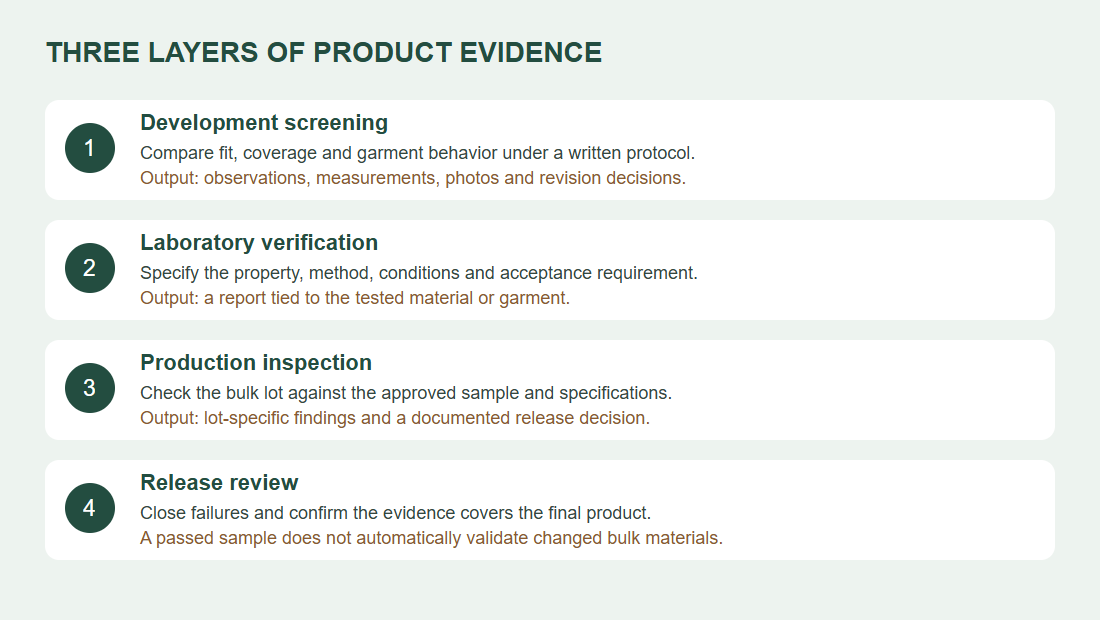
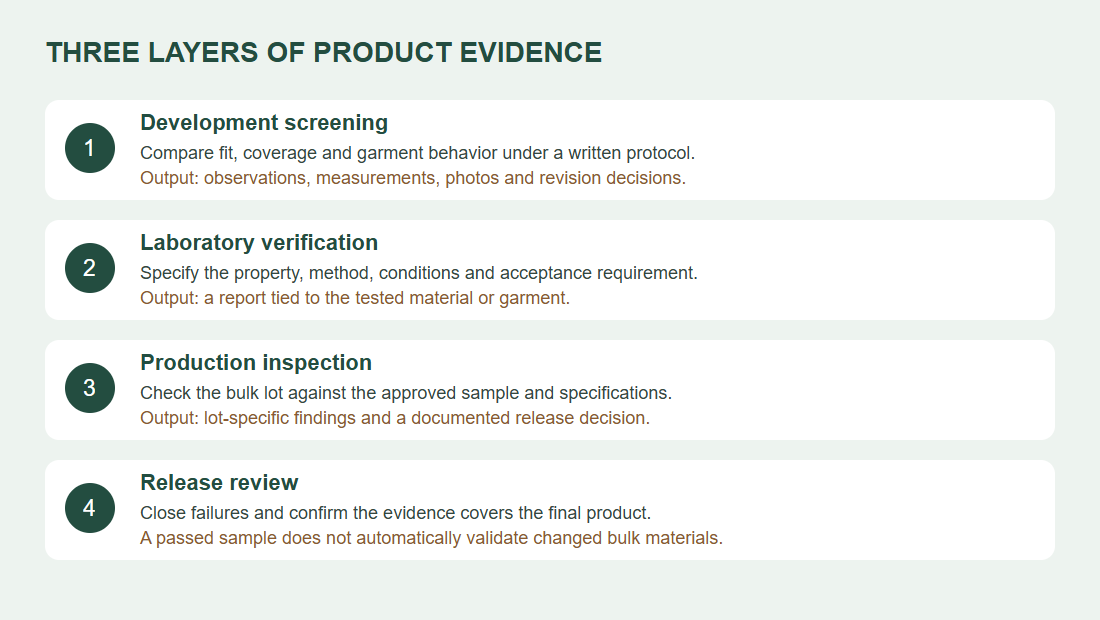
Three activities serve different purposes. Development screening finds design weaknesses through repeatable comparisons. Laboratory testing evaluates a defined property using a specified method. Production inspection checks whether manufactured garments meet the approved specification and agreed inspection plan. Passing one activity does not establish that the others have passed.
Define the intended accommodation range using relevant body measurements and proportions. Pregnancy stage alone is too imprecise for a fit specification. Ordinary activewear testing also does not establish a medical compression level, therapeutic benefit or universal suitability for every pregnant wearer.
2. Set the test brief before ordering samples
Start with the garment category and intended use. A maternity bike short, over-belly legging and nursing tank need different checks even when they use the same fabric. Identify essential product requirements and convert them into observations or measurements that a reviewer can repeat.
- Product identity: style code, pattern revision, sample date, size, color, fabric reference and trim references.
- Fit scope: body chart, garment measurements, measurement points, tolerances and intended coverage range.
- Use conditions: intended activity, movement sequence, pocket load, layering and care instructions.
- Acceptance plan: test method or screening protocol, conditions, limits, size/color coverage and approval owner.
- Claim scope: which statements need separate evidence, such as a quantified recovery or moisture-management claim.
Do not leave “good stretch,” “comfortable fit” or “premium quality” as the only criteria. For subjective feedback, use a consistent questionnaire and record where the issue occurs, under which movement and with which garment configuration.
3. The core maternity activewear testing checklist
Use the following table as a starting point. It supplies inspection questions rather than universal numerical pass limits. Assign limits before evaluation and make the sampling plan proportionate to the product, claims and order.
| Test area | What to do | What to record | Approval rule |
|---|---|---|---|
| Body and garment dimensions | Measure agreed points with a consistent relaxed-garment method. | Size, pattern revision, measured values and differences from specification. | Values meet the approved point-specific tolerances. |
| Belly-panel fit and edges | Review standing and seated coverage, folds and edge behavior. | Body measurements, panel position and location of digging or rolling. | The agreed accommodation and comfort criteria are met. |
| Waistband migration | Repeat the same comfortable movement sequence and compare position. | Start/end position, movement, garment size and fabric. | Migration stays within the brand’s pre-agreed screening limit. |
| Stretch and recovery | Screen fabric and assembled garment; define extension and rest conditions. | Direction, initial length, extension, repetitions and recovery interval. | Result meets the specified protocol; formal claims use suitable test evidence. |
| Opacity under extension | Check the actual color and garment at representative fit extension. | Lighting, background, dry condition, viewing angle and sample ID. | Coverage meets the written visual reference under those conditions. |
| Seams and junctions | Inspect crotch, gusset, panel joins, hems and elastic attachments. | Skipped stitches, broken threads, opening, puckering and discomfort. | No prohibited defects; required seam testing meets its specification. |
| Laundering and shape | Follow the proposed care procedure and remeasure after defined conditioning. | Before/after dimensions, care cycles, appearance and panel behavior. | Dimensional and appearance changes remain within agreed limits. |
| Color transfer and appearance | Screen contrasting contact surfaces; specify laboratory checks as needed. | Colorway, contact condition, observed transfer, pilling or shade change. | Relevant colorfastness and appearance requirements are satisfied. |
| Pockets, closures and nursing access | Test the intended load, opening route and repeated normal operation. | Pocket movement, closure function, access, coverage and damaged trims. | Functions meet the brief without unacceptable distortion or exposure. |
| Labels, branding and packing | Compare identity, care content, placement and approved artwork. | Label version, attachment, print appearance and packing reference. | All details match the approved specification and applicable requirements. |
A dry opacity screen does not substantiate wet opacity. A hand stretch check does not establish a standardized recovery result. Record the boundaries of each check so the evidence is not used to support a broader claim.
4. Compare test priorities by garment type
| Product | Highest-priority checks | Easy-to-miss issue |
|---|---|---|
| Over-belly leggings | Panel shape, rise balance, waistband migration, crotch seams and opacity. | The fabric passes as a swatch but becomes translucent at fitted extension. |
| Under-belly leggings or shorts | Band placement, edge comfort, movement stability and coverage. | The upper edge feels acceptable standing but digs during sitting. |
| Maternity tops | Front length, bust and abdomen allowance, armhole and hem behavior. | A wide enough top still rides up because front length is insufficient. |
| Nursing activewear | Access opening, closure function, coverage and seam comfort. | A closure works alone but distorts the neckline when assembled. |
| Coordinated sets | Separate top/bottom fit checks, shade and care compatibility. | A matching color name conceals a visible shade difference between fabrics. |
Select representative sizes and body proportions according to risk. Include size-range endpoints or other grades where panel construction, seam position or fit changes materially. A successful base size is evidence about that sample, not automatic approval of the full range.
5. Follow a six-step sample approval workflow
- Freeze the first test specification. Identify the actual fabric, trims, size chart and pattern revision. List decisions that remain open; an unidentified material makes results difficult to reuse.
- Establish a baseline. Photograph the garment and measure the specified points before wear or washing. Keep an untouched reference where practical.
- Run a repeatable fit review. With willing adult participants, use comfortable ordinary movements such as standing, sitting, walking and reaching. Record garment behavior and participant feedback. Stop a review if discomfort occurs; a clothing fit session is not an exercise assessment.
- Evaluate care and durability. Use separate specimens when destructive or sequential tests could affect each other. Repeat relevant fit and coverage checks after the defined care procedure.
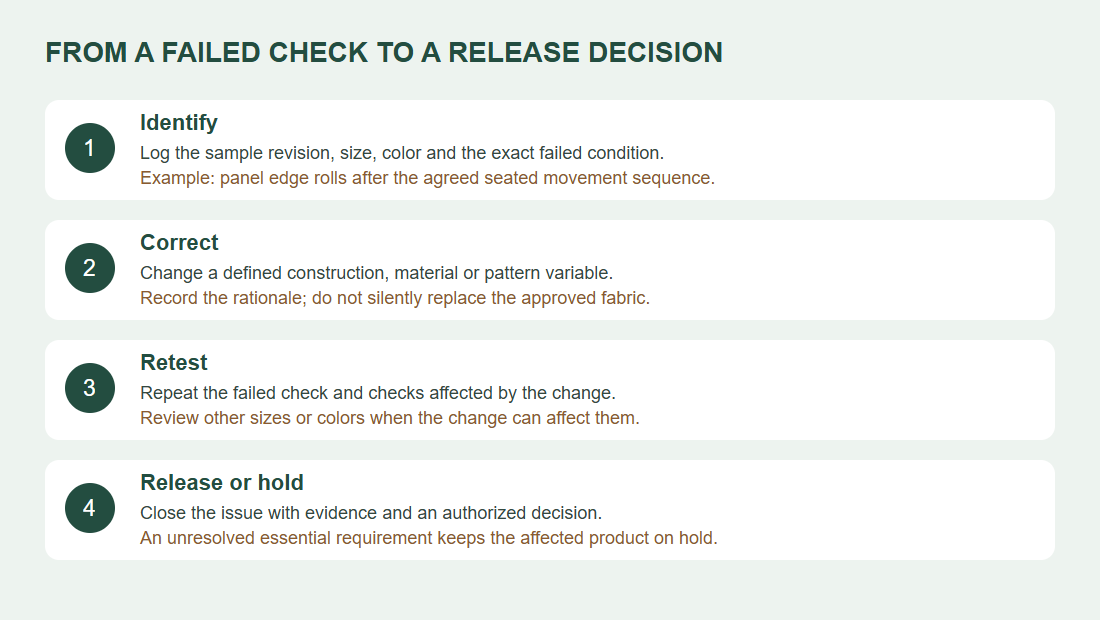
- Correct and retest. Link each failure to a proposed change, revise the sample identifier and repeat affected checks. A fabric substitution can require pattern, seam and opacity checks again.
- Approve the production reference. Sign off the final sample, technical pack, material references, inspection requirements and outstanding-issue status together. Confirm which bulk samples or lots require additional checks.
Protect participant privacy. Use only the measurements and photographs needed for the review, obtain permission for any images and avoid using identifiable fit-session images as marketing content without separate consent.
6. Keep a test record that supports a real decision
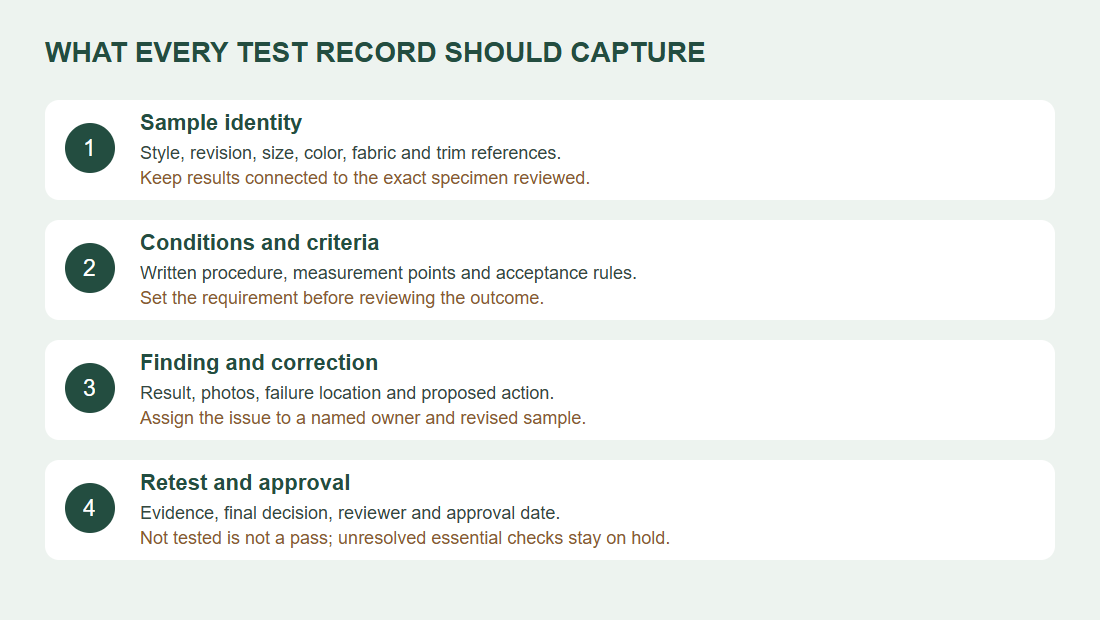
A useful record should allow another reviewer to understand what was tested and reproduce the evaluation. A photograph without a sample identity or test condition is weak approval evidence.
| Record field | Example entry — illustrative only |
|---|---|
| Sample identity | MAT-L01 / revision C / size M / black / fabric F02 |
| Requirement | Panel edge remains flat during the agreed seated-fit sequence. |
| Protocol | Written screening procedure FIT-02; defined movement and observation points. |
| Finding | Upper edge rolls at the front; record location and comparison images. |
| Action and owner | Pattern technician reviews panel edge shape and seam tension. |
| Retest and decision | Revision D reviewed against FIT-02; attach result and approval date. |
Use “pass,” “fail” and “not tested” consistently. A missing report is not a pass. A supplier concession should name the deviation, affected quantity and approving person. For failures involving an essential requirement, hold release until an acceptable correction or valid product decision is documented.
7. Plan testing cost and time before the launch date
The budget depends on sample rounds, size/color coverage, care cycles, specialist tests, specimen quantities and whether retesting is needed. Request separate quotations for development samples, laboratory work, additional sample sets and courier charges. There is no reliable universal testing price for every maternity collection.
| Cost or time driver | Why it changes the plan | Useful control |
|---|---|---|
| More constructions and colors | Different panels, finishes or dyes can change the relevant risks. | Group only demonstrably comparable variants; document why. |
| Repeated care cycles | Washing, drying, conditioning and remeasurement take elapsed time. | Reserve specimens and book review time before production approval. |
| Laboratory scope | Method, property, sample preparation and reporting affect the quote. | Confirm specimen needs, turnaround and report scope in writing. |
| Revision loops | Each change may reopen fit, coverage or durability questions. | Prioritize high-impact failures and track every revision. |
| Material availability | A substitute may invalidate earlier approvals. | Identify the production material before final validation. |
A practical schedule separates material confirmation, first sampling, fit review, care/laboratory evaluation, revisions, final approval and production release. Some independent checks can run in parallel, but final approval depends on closure of the required results. Ohsure sample timing is confirmed after reviewing the design, materials and customization requirements. Bulk-production timing depends on approved specifications, material availability and the production schedule.
8. Common testing mistakes that weaken an approval
- Approving only appearance. Add movement, care and construction checks so an attractive sample is also evaluated in use.
- Using one size for every fit claim. Check the grades and body proportions most likely to reveal a problem.
- Changing conditions between comparisons. Keep lighting, measurement procedure, care instructions and observation points consistent.
- Writing numerical limits after seeing the result. Agree requirements first; otherwise a weak result can become its own acceptance standard.
- Confusing factory screening with certification. Identify the actual method, report and tested specimen before using a performance claim.
- Ignoring assembled-garment behavior. Test the panel, elastic, seams and body fabric together.
- Skipping validation after substitution. Reassess affected checks when fabric, trim, printing or construction changes.
- Copying an acceptance plan from an unrelated garment. Adapt the checklist to the actual product and target use.
9. A manufacturer’s perspective: connect the checklist to production
For a brand working with Ohsurewear, the useful discussion is how sample findings become controlled production requirements. The supplied company fact library identifies sample development, pattern-design support, material selection, customization and quality inspection among its advertised services. These capabilities provide a basis for discussing an approval plan; they do not establish a documented result for a particular maternity style.
Ohsure’s recorded inspection stages cover raw materials, printing, semi-finished products and finished garments. For a maternity project, a suggested application is to connect fabric identity and shade at intake, print compatibility during decoration, panel and seam construction during assembly, and final dimensions and appearance at garment inspection. This mapping is a proposed buyer checklist rather than a verified internal factory procedure.
Ask the factory to confirm measurement tolerances, sampling rules, applicable methods, records supplied and which checks need an external laboratory. Do not assume an AQL agreement, independent certification or quantified performance result from a general service description. The practical manufacturing lesson is to attach every approval to an identifiable specification and preserve that link through bulk production.
10. Frequently asked questions
What should a maternity activewear testing checklist include?
Include garment measurements, belly-panel and waistband fit, movement stability, stretch and recovery, opacity, seam quality, laundering, color transfer, functional details and labels. Add product-specific checks and define evidence and acceptance rules before sampling.
Is a hand stretch test enough to approve fabric?
It is useful as an initial comparison, but it does not quantify performance under a recognized laboratory method. Confirm the actual fabric in the assembled garment and obtain suitable test evidence for specific performance claims.
How many sizes should a brand test?
There is no universal number. Select sizes and body proportions according to the grading and construction risks, including relevant range endpoints. Record what was covered and do not extend conclusions beyond the reviewed scope.
Should opacity be checked in every color?
Opacity can vary by color, construction and extension. Define coverage for the actual colorways and prioritize variants that may behave differently. A black sample alone does not validate a pale production color.
How do I assess waistband rolling?
Use a repeatable comfortable movement sequence and record the edge position, body measurements, sample identity and where rolling occurs. Review panel contour, edge finish, seam tension and pull from the garment body before selecting a correction.
Does washing need to happen before final approval?
When care performance is a requirement, complete the agreed care evaluation before approval. Measure changes and recheck affected fit and functional details. Specify the procedure and cycle count rather than saying only that the sample was washed.
Does this checklist prove pregnancy safety or medical support?
No. It is a garment-development and quality framework. Ordinary fit, comfort and durability checks do not establish clinical outcomes, therapeutic benefits or a medical compression classification.
What should I send Ohsure to request testing and sampling support?
Send the style references, technical pack, body and garment charts, materials, intended use, quantities per style/color, target market, claims, care plan and required evidence. Ask for the scope, price, timing and responsibility for every requested check.
11. Turn the checklist into your next sample brief
Start with the custom maternity and nursing activewear product collection to define the garments in your range. Discuss category development through Ohsure’s maternity activewear manufacturing service, or coordinate a broader project through its OEM and ODM inclusive activewear service.
Send a marked-up checklist with your sample request. Identify the checks the factory should perform, the evidence you require and the decisions your brand retains. Approve the final materials, measurements and construction together so the bulk order follows a clear reference.
Sources and scope
Company facts follow the buyer-supplied Ohsure article fact library. Official reference pages: maternity manufacturing, OEM/ODM services and maternity and nursing products. The checklist, diagrams and example record are editorial recommendations, not reported test results or an audited factory case study. Test methods, numerical limits and target-market requirements must be selected for the actual project.