Maternity Legging Waistband Design: Over-Bump vs Under-Bump
- Share
- Issue Time
- Oct 28,2026
Summary
Compare over-bump and under-bump maternity legging waistbands: construction, fabric, fit checks, sample approval, costs and manufacturing considerations.
B729-67 · MATERNITY ACTIVEWEAR DEVELOPMENT
Direct answer
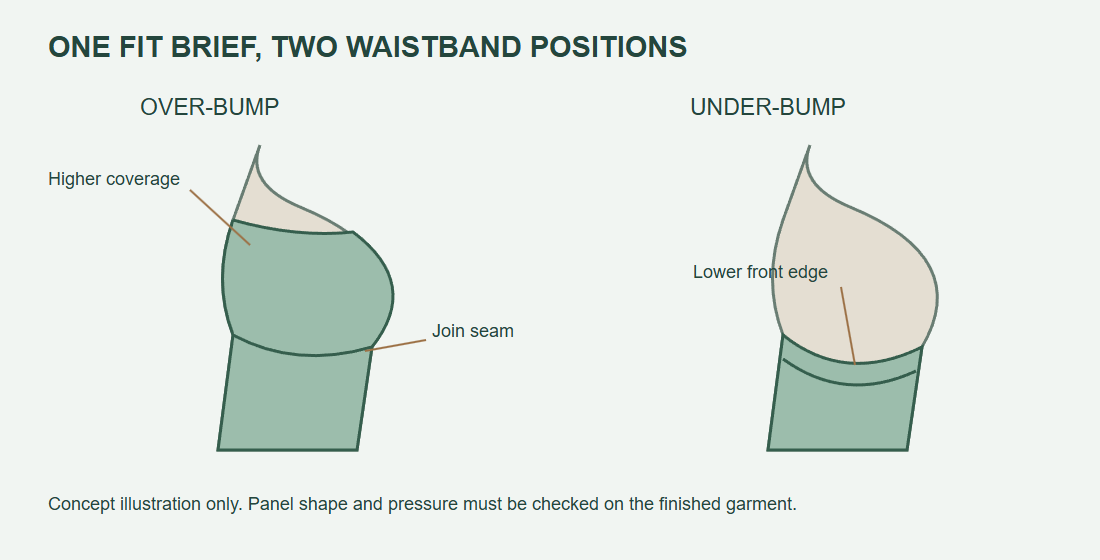
Choose an over-bump waistband when the brief prioritizes abdominal coverage and a tall stretch panel; choose an under-bump waistband when the wearer prefers a lower front edge and less abdominal coverage. Neither construction is universally more comfortable. Compare matched samples for sitting comfort, rolling, slippage, seam pressure and recovery across the intended body measurements before approving bulk production.
For a maternity activewear brand, waistband placement affects more than the silhouette. It changes the coverage, panel geometry, seam location and fit questions that must be resolved before grading. A tall panel can feel comfortable at the belly yet restrictive at its top edge; a lower band can clear the abdomen yet migrate when the wearer sits. The useful comparison starts with the intended wearer and ends with a controlled sample review.
1. What do over-bump and under-bump mean?
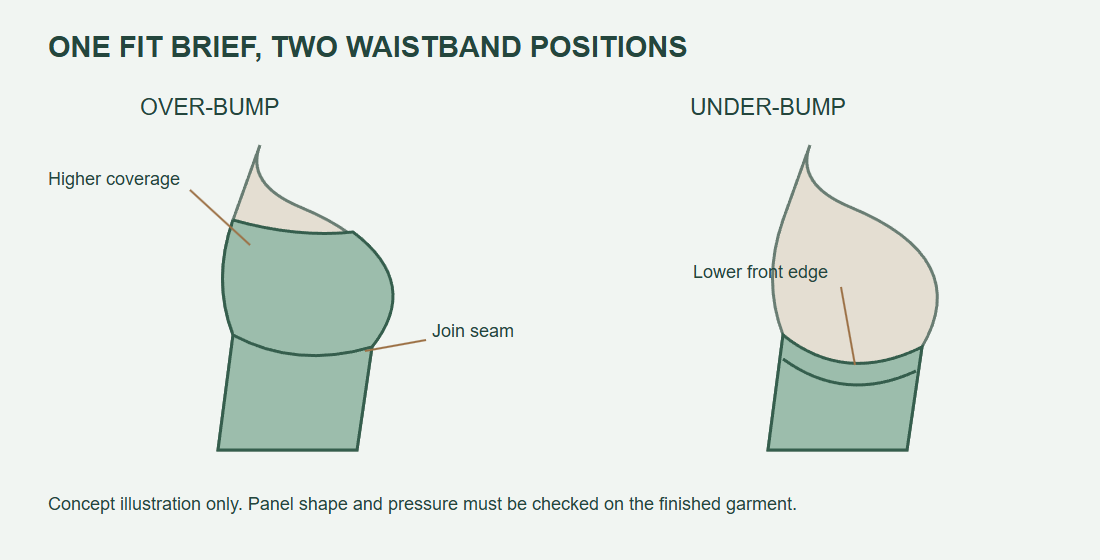
Over-bump maternity leggings use a tall waist panel intended to extend over the abdomen. The panel may use a different fabric, lining or construction from the legs. Its upper edge, front height and side contour determine where it sits on the intended body.
Under-bump maternity leggings have a lower front waist intended to sit below the abdomen, often with a shaped or curved front. Side and back height can differ from front height. “Under-bump” describes placement; it does not establish a medical lifting function. In Chinese, 托腹 can suggest therapeutic support, so the English specification should state the actual construction rather than imply treatment.
A fold-over waistband is a third construction choice, not automatic proof that one design fits both positions. Folding changes thickness, edge location and the effective circumference. Assess both configurations if the product will be marketed for both. Likewise, a regular high-rise legging enlarged by one size is not a complete maternity fit strategy.
2. Over-bump vs under-bump: a development comparison
| Design factor | Over-bump | Under-bump | Approval question |
|---|---|---|---|
| Coverage | Tall panel covers more of the abdomen | Lower front leaves more abdomen uncovered | Does the wearer prefer this coverage with the intended top? |
| Pattern priorities | Front panel height, contour and upper edge | Front curve, side height and back rise | Does the waist sit where the specification intends? |
| Potential fit issues | Top-edge rolling, panel bunching or restriction | Front-edge digging, migration or back gaping | What happens during sitting and approved movement? |
| Material decisions | Panel extension, recovery, lining and heat feel | Band geometry, elastic behavior and seam stretch | Does the assembled waist recover and remain comfortable? |
| Possible complexity | May need a separate panel fabric or additional layer | May need carefully shaped pattern pieces and stabilization | What construction does the quoted price actually include? |
| Fit over time | Extra coverage does not guarantee a whole-pregnancy fit | Lower placement does not guarantee accommodation of all changes | Which body measurement range was actually evaluated? |
There is no universal winner by pregnancy stage. Some wearers prefer coverage; others dislike fabric over the abdomen. Stage labels alone do not capture differences in abdomen shape, hip size, torso length or personal preference. If a brand chooses stage-related positioning, it needs an appropriate fit program rather than a single sample on a single wearer.
3. Engineer three zones rather than selecting height alone
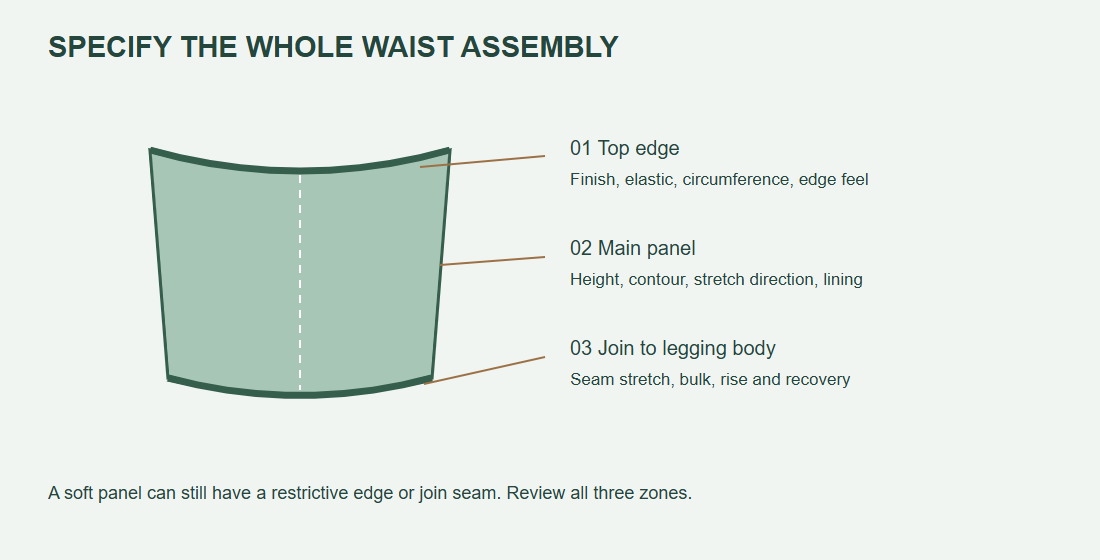
Top edge. Specify whether it uses a fold, binding, enclosed elastic or another finish. Record the construction and finished circumference under defined measuring conditions. A soft main panel does not compensate for an edge that rolls or creates an uncomfortable narrow contact line. If an adjuster is proposed, assess access, security, bulk and skin contact.
Main panel. Define center-front, side and center-back heights separately. Include the fabric reference, stretch direction, layer count and seam placement. A straight rectangular panel is only one starting geometry; its suitability depends on the target fit. Do not assume that a higher elastane percentage automatically gives a more suitable fit or greater comfort.
Join to the legging body. Check whether the seam can extend with the surrounding fabrics and recover without damage. Inspect bulk, scratchy ends, skipped stitches and distortion. Review front and back rise, crotch balance, hips and thighs together: a leg body that pulls downward can make a reasonable waistband appear unstable.
For under-bump designs, review the front curve in sitting as well as standing. For over-bump designs, check upper-edge behavior with the panel fully extended. Moving a troublesome edge to another height without reassessing pattern balance can simply relocate the problem.
4. Choose fabric through assembled-sample checks
Start with the required hand feel, coverage, extension and recovery, then compare suitable fabric references. Ohsure’s supplied fact library lists nylon/spandex and polyester/spandex among its fabric options, alongside other blends. Confirm the exact composition, weight, color, finish and availability for the project; a general fabric list is not a stock guarantee.
| Check | Why it matters | What to record |
|---|---|---|
| Extension and recovery | Panel and leg body may behave differently | Direction, conditions, extension method and residual change |
| Coverage under extension | Appearance can change when fabric stretches | Color, lighting, body position and visible show-through |
| Layer compatibility | Lining may restrict or distort the shell | Relative movement, bunching and change after care |
| Seam and edge behavior | A join or elastic may limit the assembly | Restriction, seam damage, rolling and wearer comments |
| Care behavior | Fit can change after washing and drying | Agreed care method, cycles and before/after measurements |
If numerical stretch or recovery results will be used for purchasing, agree a repeatable method with the supplier or laboratory. Record specimen dimensions, conditioning, load or extension, hold time and recovery interval. Hand stretching can help screen options but cannot establish a standardized result, a body-pressure value or a medical benefit.
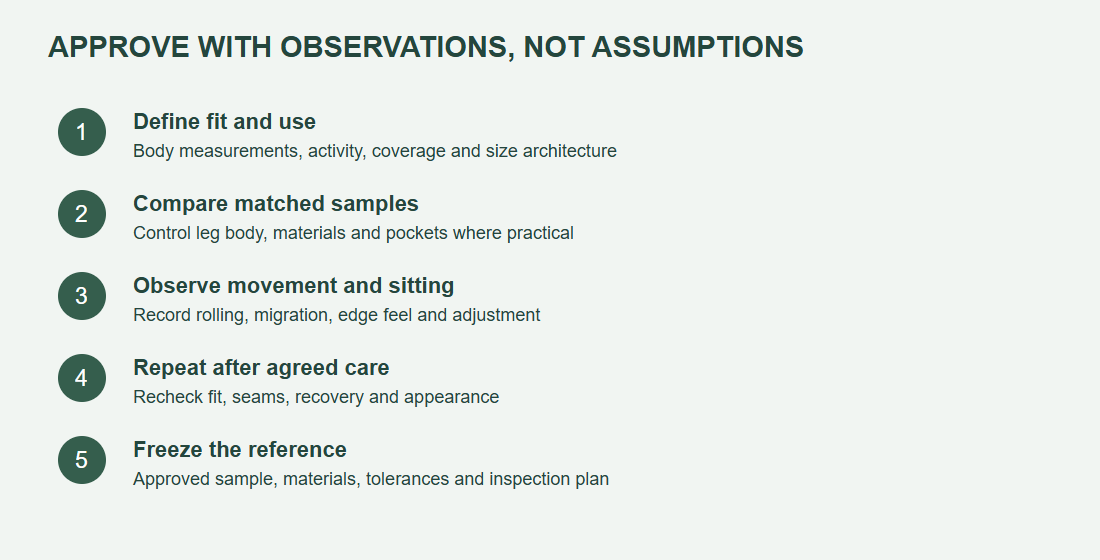
5. Follow six steps before bulk approval
- Define the wearer and use case.
Set the body measurement ranges, intended activity, coverage preference, care instructions and claims. Separate body dimensions from finished garment measurements. Include pockets and intended pocket loading in the brief if they are part of the product.
- Build a matched comparison.
Develop over-bump and under-bump prototypes using the same leg-body pattern and comparable materials where practical. Document every deliberate difference. If several variables change at once, the trial cannot isolate waistband placement as the cause of a preference.
- Check static fit and sitting.
Observe standing, sitting and position changes with consenting adult wearers representative of the intended range. Record front-edge contact, back coverage, folds, gaping and the need to adjust. Do not infer comfort from photographs alone.
- Observe the intended movement.
Use a suitable, wearer-appropriate movement sequence agreed with relevant specialists. Record waistband migration, rolling and pocket-related pull. The garment trial evaluates clothing behavior; it is not an exercise prescription or a determination of an individual’s suitability for activity.
- Repeat after care and review size coverage.
Use the agreed washing and drying procedure, then repeat measurements and fit observations. Include representative sizes and body proportions. A single passing base size does not validate the entire grade or a claim of fit throughout pregnancy.
- Approve a controlled production reference.
Freeze the revised pattern, bill of materials, measurement points, tolerances, stitching, label locations and inspection requirements. Retain the approved sample. Reassess affected properties if the panel fabric, elastic, seam or supplier reference changes.
6. Record outcomes without inventing test data
Use a comparison log to turn “this feels better” into actionable development feedback. The table below is a proposed record format, not a report of Ohsure testing. Agree the protocol and acceptance criteria before evaluating samples. Keep individual observations and failures visible rather than relying only on an average preference score.
| Observation | Record for each sample | Use in the decision |
|---|---|---|
| Waist position | Starting position and migration after the same task | Investigate changes against the intended placement |
| Rolling or folding | Location, task, recurrence and adjustment needed | Distinguish a persistent defect from an intended fold |
| Comfort feedback | Wearer description, location and relevant task | Review localized discomfort and pattern/material causes |
| Care change | Measurement change, distortion and appearance | Compare with the agreed tolerance and care conditions |
| Fit coverage | Body measurements, sample size and fit outcome | Identify missing size or proportion coverage |
For a simple dimensional check, percentage change equals (after measurement − before measurement) ÷ before measurement × 100. Measure at the same marked points and under the same agreed conditions. This calculation describes dimensional change only. It cannot be converted into abdominal pressure or a “safe compression” threshold. If pressure is a product requirement, seek a qualified measurement plan and specialist interpretation.
7. What changes cost and development time?
| Driver | Effect on cost or timing | Buyer action |
|---|---|---|
| Separate panel material | Additional sourcing, color matching and possible material minimums | Confirm fabric references and minimums before costing |
| Layers and finishing | Lining, elastic and special finishes add materials or operations | Compare the same bill of materials and seam specification |
| Pattern and grading | Front shaping and size architecture require development | Budget base-size revisions and representative size reviews |
| Fit and care evaluation | Samples, wearer feedback and repeat checks take time | Include review loops in the critical path |
| Branding and delivery | Labels, packing and transport change total cost | Request itemized terms and a confirmed delivery arrangement |
Do not assume that under-bump is cheaper because it uses less panel fabric. A shaped, lined or adjustable lower band may require more operations than a simple tall panel. Ask for two quotations against written specifications, including development charges, sample revisions, unit price, labeling, packing, agreed testing and shipping terms.
Ohsure’s published MOQ starts at 100 pieces per style per color, with mixed sizes available; final order requirements are subject to project confirmation. If two waistband versions are treated as separate styles, each may need its own style/color minimum. For example, two versions in two colors would imply 400 pieces if that minimum applies to all four combinations. This is a planning illustration, not a confirmed order requirement.
Sample timing is confirmed after reviewing the design, materials and customization requirements. Bulk-production timing is confirmed according to the approved specifications, material availability and production schedule. Plan material confirmation, first sample, buyer feedback, revisions, size review and approval as separate milestones. Include delivery transit separately from production rather than publishing an unsupported fixed lead time.
8. Common mistakes that weaken the comparison
- Choosing by a trimester label alone. Build the fit brief around measurements, shape, use and wearer preference.
- Adding height to a standard waistband. Reassess front contour, rise balance and the connection to the leg body.
- Fixing slippage by tightening every component. First identify whether the cause is the leg pattern, fabric recovery, seam or waistband geometry.
- Testing only while standing. Sitting and position changes may reveal edge or coverage problems hidden in a product photograph.
- Approving softness instead of function. Check recovery, seams, layers and care behavior together.
- Calling ordinary garment coverage medical support. Claims of pain relief, therapeutic compression or recovery require a separate evidence and compliance assessment.
- Claiming postpartum suitability by assumption. Evaluate that use case separately if it will appear in product copy.
9. Manufacturer perspective: make the brief inspectable
Ohsurewear is a Dongguan-based manufacturer offering OEM, ODM and private-label activewear, including maternity and nursing garments. The supplied fact library describes design-reference review, sample development, garment production and packaging customization. Those capabilities can support either waistband concept, but they do not establish that a particular prototype has passed fit or performance testing.
The practical manufacturing lesson is to replace “soft and supportive” with a controlled specification: panel fabric reference, front/side/back heights, top-edge construction, seam details, finished measurements and an approved sample. This is development guidance drawn from the manufacturing requirements, not an invented factory case study or a claim of measured results.
Ohsure’s documented quality-control scope includes raw materials, printing, semi-finished sampling and finished garments, with checks such as appearance, measurements, stitching and accessories. Agree which waistband features must be checked, how samples will be selected and what happens when a result falls outside the approved specification. Inspection activities alone do not establish a particular AQL, certification or zero-defect guarantee.
10. Frequently asked questions
Is over-bump better than under-bump?
Neither is universally better. Over-bump prioritizes higher coverage; under-bump prioritizes a lower front edge. Decide using matched samples, wearer feedback and the intended fit range rather than a universal comfort ranking.
Can one waistband work throughout pregnancy?
That is a claim to validate, not an automatic result of stretch fabric. Define the measurement range and evaluate relevant body proportions. State the supported fit range clearly instead of promising universal accommodation.
Will a lower waistband stop rolling?
Not necessarily. Rolling can involve height, contour, elastic, material recovery or leg-body tension. Locate the cause during sitting and movement checks before changing the design.
Can an over-bump waistband be folded down?
Only market it that way after checking the folded configuration. Folding changes thickness and edge pressure and may affect stability or appearance.
What fabric composition should a brand specify?
Specify performance and construction requirements before selecting an exact blend. Compare available references for extension, recovery, coverage, hand feel and care behavior in the finished garment. Composition alone does not predict the outcome.
Does under-bump mean medical abdominal support?
No. It describes the position of the waistband. Ordinary maternity leggings should not be presented as a medical support device or treatment without the appropriate evidence and market-specific review.
What should I send to a manufacturer for a quotation?
Send the waistband concept, reference images, target size chart, panel heights, materials, construction, pocket details, colors, quantity per style/color, branding, packing and evaluation requirements. Identify any specifications still open for development.
11. Move from concept to a sample brief
Review the maternity and nursing activewear product collection for product directions, then use the custom maternity activewear service to discuss a waistband development brief. The custom activewear manufacturing service provides a broader starting point for a coordinated range.
Request an over-bump and under-bump comparison against the same intended wearer, leg silhouette and approval criteria. Choose the version that meets the documented brief, then approve materials and construction before authorizing production.
Sources and scope
Company facts are based on the buyer-supplied Ohsure article fact library. Current product and service destinations were checked on 28 October 2026: product collection, maternity development service and manufacturing service. Construction comparisons, diagrams and recording templates are editorial development guidance; no sample test results, medical outcomes or independent certifications are asserted.