What Is GSM in Activewear Fabric and How Do You Choose the Right Weight?
- Share
- publisher
- Ohsure
- Issue Time
- Sep 22,2026
Summary
Learn what GSM means in activewear fabric, compare practical weight ranges by garment, and use a clear approval process before bulk production.
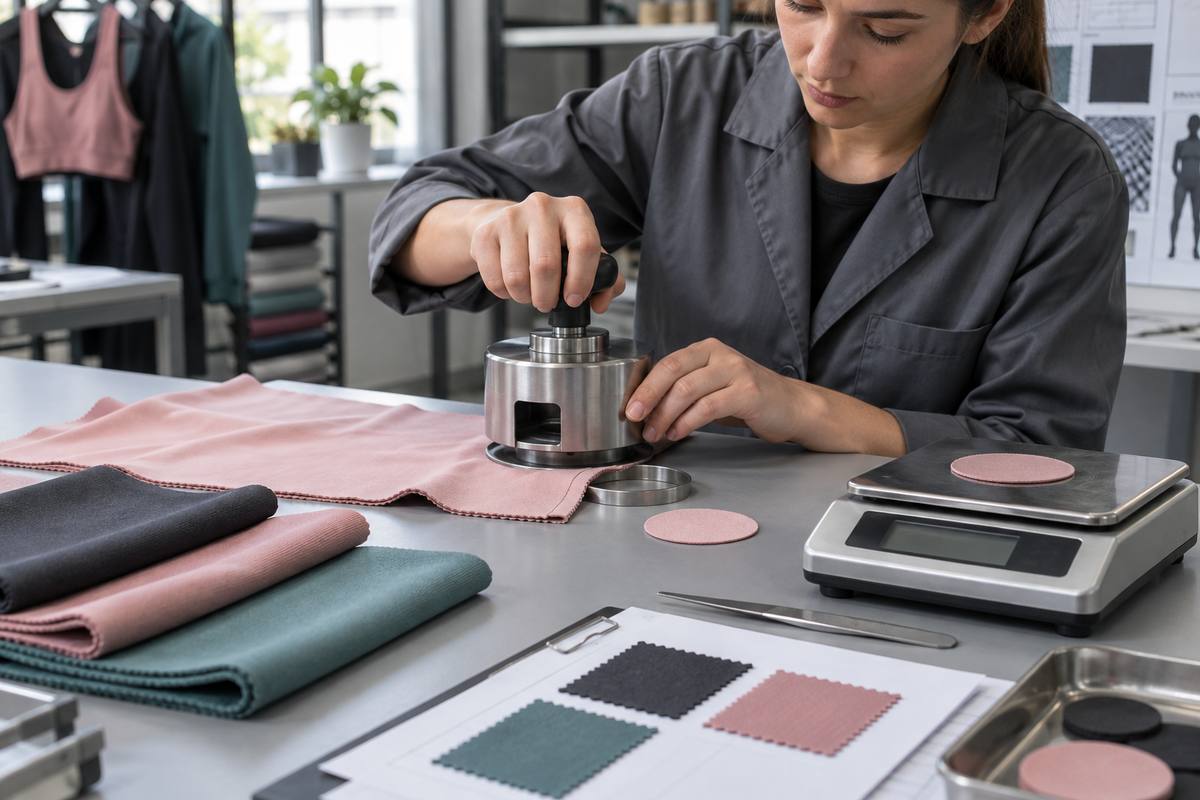
Activewear fabric weight guide
GSM means grams per square metre. It tells you how much one square metre of fabric weighs. Use it to compare fabric mass, estimate garment feel and control sourcing consistency, but never use GSM alone to predict opacity, compression, breathability or durability.
For activewear, start with the garment and activity. A light running top may begin around 110–170 GSM, while many leggings begin around 200–280 GSM. These are sourcing ranges for initial sampling, not universal standards or Ohsure test results. Construction, fiber, finish, color and fit can change the outcome.
1. What Does GSM Measure?
GSM is an area-based mass. If a conditioned fabric specimen has a known area, divide its mass in grams by its area in square metres:
A 10 cm × 10 cm specimen covers 0.01 m². If it weighs 2.20 g, its calculated mass is 220 GSM. Laboratories may use full-width samples, small swatches or other procedures defined by the selected method. Do not assume a single hand-cut square represents an entire roll.
ISO 3801 covers mass per unit length and mass per unit area for woven fabrics, including stretch types. ASTM D3776/D3776M covers fabric mass per unit area and provides options for full pieces, full-width samples, small swatches and narrow fabrics. The method and sampling plan matter because a small swatch describes that swatch more confidently than the entire shipment.
GSM and oz/yd² are the same idea in different units
Some suppliers use ounces per square yard. Use 1 oz/yd² ≈ 33.906 GSM. For example, 6 oz/yd² is about 203 GSM. Keep the original supplier unit in the specification and record the conversion separately to avoid rounding disputes.
2. A Practical GSM Range Map for Activewear
The ranges below are useful starting points for development briefs. They are intentionally broad because a compact knit and an open mesh at the same GSM will not wear the same way.
| Fabric weight | Working description | Common activewear starting points | Main questions to test |
|---|---|---|---|
| Below 150 GSM | Ultralight | Breathable panels, race singlets, ultralight tops | Is it too sheer when wet or stretched? Does it snag or cling? |
| 150–190 GSM | Lightweight | Training tees, running tops, light shorts and liners | Does it dry comfortably? Is the hand feel suitable after washing? |
| 190–240 GSM | Midweight | Versatile tops, shorts, light leggings and studio layers | Does it balance coverage, drape and temperature for the target use? |
| 240–300 GSM | Substantial | Many leggings, fitted bottoms, supportive studio pieces | Is the fabric overly warm? Does it recover after repeated stretch? |
| Above 300 GSM | Heavyweight | Cold-weather layers, structured or brushed styles | Does bulk affect mobility, seams, drying and cost? |
These labels are not regulated categories. A 250 GSM nylon–elastane tricot, polyester interlock and brushed knit can differ strongly in thickness, stretch force, surface and air flow. Use GSM to narrow a shortlist, then approve the exact quality.
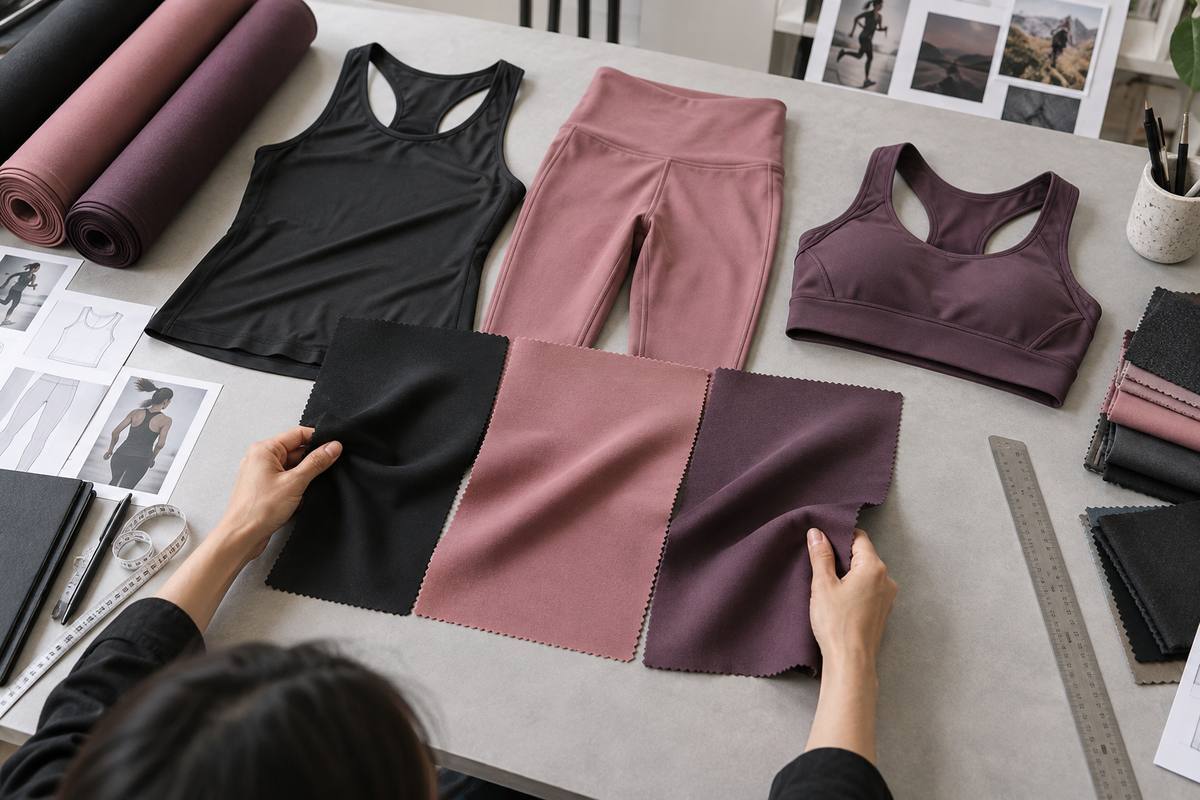
3. Choose GSM by Garment and Use Case
Running and high-sweat tops
Begin around 110–170 GSM when low garment mass and quick moisture release are priorities. Check wet cling, air permeability, drying and transparency. A lighter fabric is not automatically cooler if its structure limits air exchange or its finish holds moisture against the skin.
Training T-shirts and tanks
Begin around 140–190 GSM for a balance of drape, coverage and everyday durability. Move upward when the brief calls for a more substantial hand or less show-through. Move downward for race-oriented products, but confirm seam stability and abrasion at pack or equipment contact points.
Shorts and skorts
For a shell, begin around 120–180 GSM; for a stretch body fabric, around 170–230 GSM may be more useful. The waistband, liner and pocket can each use a different material. Record GSM by component rather than assigning one number to the whole garment.
Leggings
Many development briefs begin around 200–280 GSM. Lower weights may suit light studio styles; higher weights may support a more substantial feel. GSM does not guarantee squat-proof coverage or compression. Check color, stretch direction, elongation under load, recovery, waistband construction and the finished garment on the target size range.
Sports bras
Begin around 220–320 GSM for the main shell when the design needs a firmer hand, then engineer support through the whole garment. Lining, elastic, straps, cups, seams and pattern geometry can matter more than adding fabric weight. Do not publish a support claim from GSM alone.
Jackets and cold-weather layers
Heavier or brushed fabrics can provide more material and loft, but insulation is not a direct GSM reading. Construction, trapped air, wind resistance and moisture management influence warmth. Sample the complete layer system for the intended climate.
4. Why Two Fabrics at the Same GSM Can Perform Differently
GSM answers “how much mass per area?” It does not answer “how is that mass arranged?” Compare these factors before treating two fabrics as substitutes:
- Fiber and blend: nylon, polyester and elastane affect feel, dyeing, moisture behavior and cost differently. The nylon vs polyester guide helps frame that choice.
- Yarn: filament count, texturing and yarn size influence softness, bulk, cover and snag behavior.
- Construction: jersey, interlock, tricot, mesh and spacer structures distribute yarn differently.
- Thickness: two fabrics may share GSM but not thickness. ISO 5084 addresses thickness determination under specified pressure.
- Finish: brushing, coating, wicking treatments and compacting can change hand, bulk and performance.
- Color: pale and dark versions of one quality can look different when stretched, even with similar GSM.
For a replacement material, match the functional brief rather than GSM alone. The activewear fabric guide connects mass, stretch, recovery and performance testing in one sourcing framework.
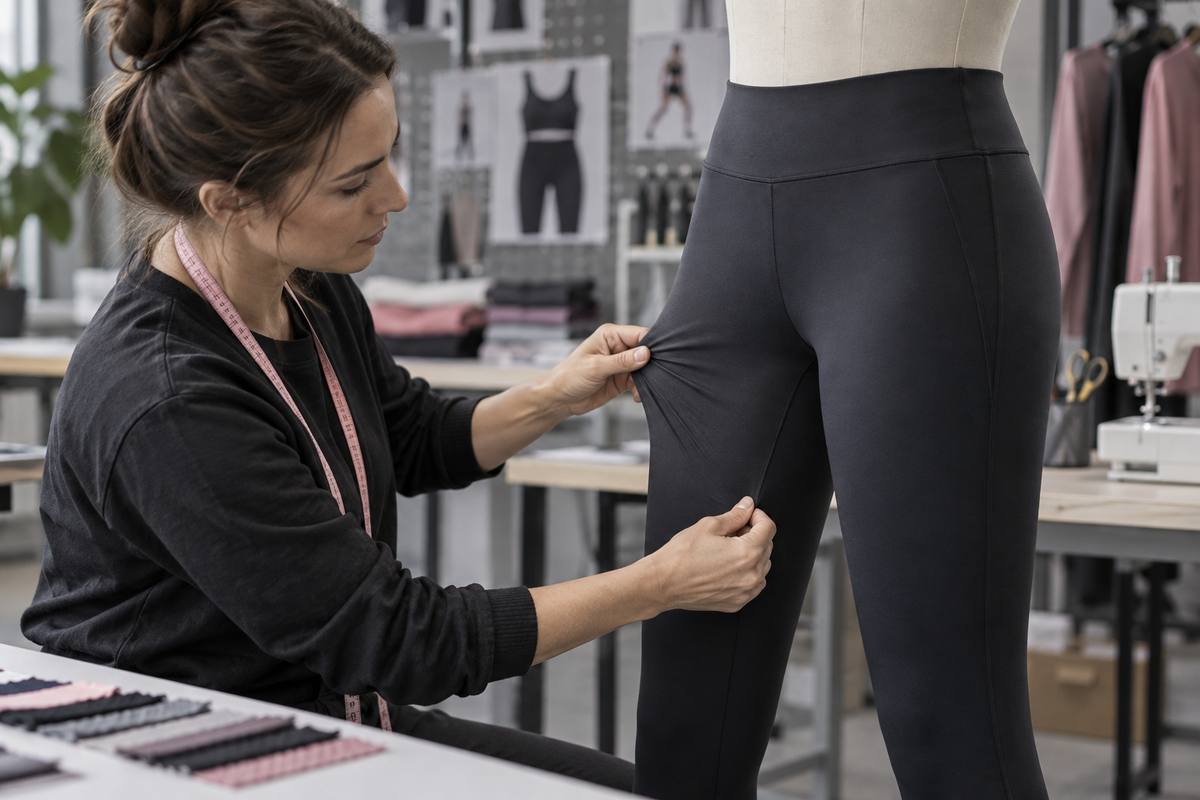
5. How to Verify GSM Before Bulk Production
- Name the method. Put the test method and edition on the specification or report. State whether the material is knit or woven and confirm method suitability with the laboratory.
- Condition the specimens. Moisture and atmosphere can change measured mass. ISO 139 specifies standard atmospheres for conditioning and textile testing.
- Define sampling. Take specimens across usable width and from more than one roll or location when assessing a lot. Avoid selvages unless the method or agreement requires them.
- Use suitable equipment. A calibrated balance and accurately known specimen area are essential. A GSM cutter can simplify small-specimen work, but a single cut does not create a robust lot-sampling plan.
- Report individual results. Keep each result, the average, sample identity, conditioning, date and operator or laboratory. An average without spread can hide variation.
- Connect the result to approval. Attach the record to the approved fabric code, color and lot. Recheck when the supplier, construction, finish or source changes.
Example tolerance discussion
If the approved target is 220 GSM, the brand and supplier must agree a tolerance and its basis before production. A percentage tolerance and an absolute tolerance are not interchangeable. “220 GSM ±5%” means 209–231 GSM; “220 GSM ±5 GSM” means 215–225 GSM. These examples explain the math and are not recommended acceptance limits.
6. Use a Fabric Approval Card
| Field | What to record | Why it matters |
|---|---|---|
| Identity | Supplier, quality code, composition, color, lot and finish | Prevents a result from being separated from the tested material |
| Mass | Target GSM, method, individual results, average and agreed tolerance | Creates an auditable weight requirement |
| Construction | Knit type, usable width, thickness where relevant and surface finish | Explains why equal-GSM candidates may behave differently |
| Stretch and recovery | Direction, method, load or extension, cycles and residual growth | Controls fit and shape retention rather than relying on elastane percentage |
| Garment check | Coverage, fit, movement, wet comfort, seams and care results | Confirms the material works in the product |
| Commercial terms | Minimums, price basis, yield, lead time and substitution rules | Connects technical approval to sourcing feasibility |
Do not fill missing evidence with a generic “pass.” Request the method, result and sample identity, or mark the item unresolved. The activewear fabric test-report guide provides a deeper comparison workflow.
7. Common GSM Buying Mistakes
“Higher GSM means higher quality”
Quality means fitness for the intended use. A heavy running top can be uncomfortable, while an ultralight fabric can fail a coverage or durability requirement. Select the lowest or highest mass only when that direction supports the brief.
“The same GSM means the same consumption”
Garment consumption also depends on usable width, marker efficiency, shrinkage and defects. Compare cost per finished garment, not only price per kilogram or metre.
“The approved color represents every color”
Color and processing can influence appearance, hand and sometimes measured properties. Approve critical pale, bright or dark colors in the actual fabric and size range.
“A supplier data sheet replaces garment testing”
A data sheet is useful evidence for fabric identity and properties, but it cannot confirm fit, seam behavior or wear experience. Keep both the fabric record and the approved garment sample.
Frequently Asked Questions
What is a good GSM for leggings?
A practical starting range is about 200–280 GSM, but the right choice depends on construction, stretch force, recovery, color, coverage and climate. Approve the sewn garment rather than a number alone.
Is 220 GSM good for gym wear?
It can be a useful mid-to-substantial starting point for leggings, shorts or fitted tops. It may be too heavy for a high-sweat running tee. Match it to the product and test the actual fabric.
Does higher GSM mean better squat-proof coverage?
No. Coverage also depends on yarn, knit density, color, stretch and fit. Check the garment while stretched on the target sizes and in realistic lighting.
Is GSM the same as thickness?
No. GSM is mass per unit area; thickness is a distance measured under defined pressure. Bulky and compact fabrics can have similar GSM but different thickness.
How do I convert oz/yd² to GSM?
Multiply oz/yd² by approximately 33.906. To convert GSM to oz/yd², divide by 33.906. Record the original unit and rounding used.
How much GSM variation is acceptable?
There is no universal tolerance for every activewear fabric. Agree the target, tolerance, test method, sampling plan and response to out-of-tolerance results before bulk production.
Build the Specification Around the Garment
Use GSM as one controlled specification, not as a shortcut for performance. Start with the activity and garment, choose a working weight range, compare exact fabric qualities, verify mass with a stated method, and approve the sewn sample.
For an Ohsure custom sportswear project, provide the garment type, intended activity, target fit, climate, preferred hand feel, artwork, size range, quantity and any approved reference garment. Ask for exact fabric codes and keep test evidence tied to those codes.
Evidence scope: ISO and ASTM links support the measurement and conditioning framework. GSM ranges, garment starting points and approval steps are editorial sourcing guidance, not industry-mandated limits or original Ohsure laboratory results.